Introduction
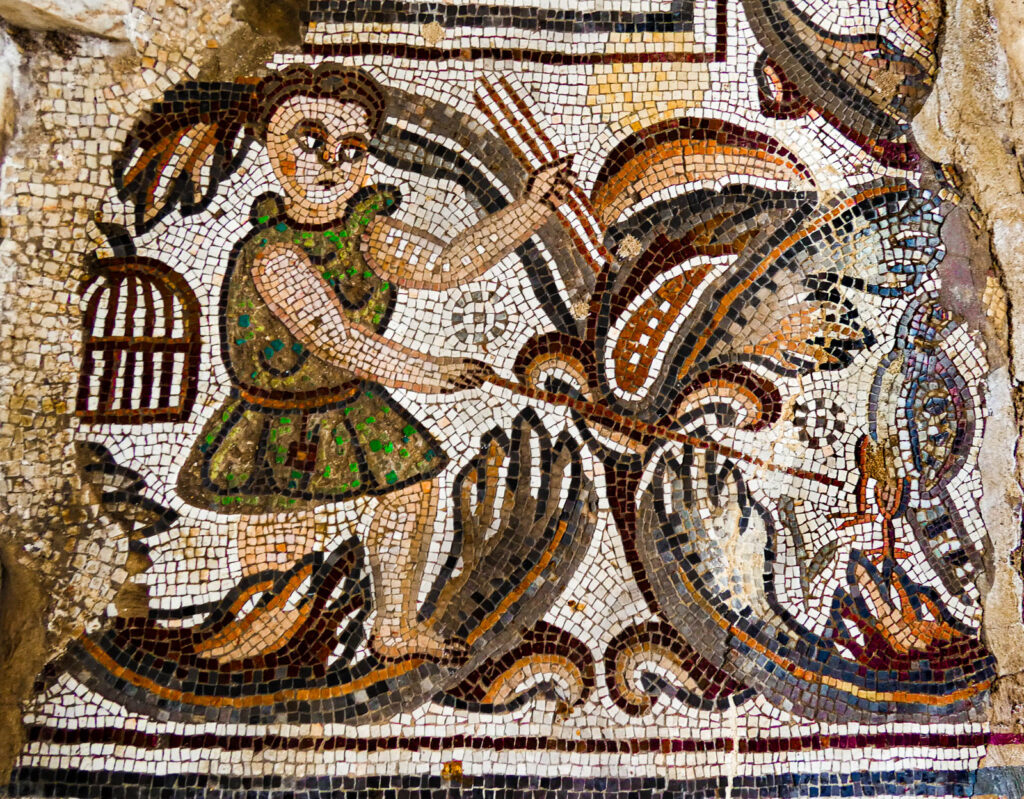
The mosaic floor of the Byzantine church on Givat Katznelson in Nahariya, from the mid-sixth century CE, covers the entire church, more than 500 m². It is one of the most impressive floors found in the Western Galilee.
In front of the bema is a scene of bird-catching with limed sticks, the only one known in the mosaics of the Land of Israel. The scene is discussed in an article published in English on Zenodo: Avital 2026, The Fowler, the Sparrowhawk and the Birds.
History of the site and the excavation
In the Byzantine period the region was densely settled, as shown by the many churches discovered there, such as those at Shavei Zion, Hanita, Evron and Hosen.
The church was discovered by chance in 1964, while foundations were being laid for a youth club. It was uncovered in two excavation seasons, in 1972 and 1974, on behalf of the Israel Department of Antiquities and Museums, directed by Gershon Edelstein. Gershon Edelstein and Claudine Dauphin later published the finds, and the full excavation report appeared in French in 1984.
In 1984 a protective shelter was built over the mosaic, donated by the German city of Bielefeld, Nahariya’s twin city. In 1988 experts from Bielefeld restored sections of the floor. In 1992 the site was closed to the public. Between 2019 and 2022 it was cleaned and conserved under the supervision of the Israel Antiquities Authority, and in April 2022 it reopened. On 10 April 2026 a rocket fired from Lebanon struck the protective shelter; the mosaic itself was not damaged. In August 2026 the site reopened to the public.
The building and its date
The church is a basilica ending in three apses, measuring 16 × 32 m. Two rows of six marble columns, with capitals carved with plant motifs, divided the hall into three parts. The columns probably carried wooden beams supporting two galleries. The roof was a timber frame covered with tiles. The walls were built of local stone, and the many fragments of glass indicate windows.
Shortly after the mosaic floor was laid, the front part of the prayer hall was enclosed by a chancel screen. It consisted of 12 marble panels carved in relief, 1.2–1.5 m wide and 0.6 m high, with 10 marble posts between them. Two panels show a pair of deer flanking a cross. One panel carries a Greek inscription dedicated to the donors of the screen: Leontis the priest and his family. Two marble tables stood within the screened area.
The Greek letters IAP are carved on several of the column capitals. They appear to abbreviate the name of an archbishop of Tyre in 555 CE, who is also mentioned in an inscription from the church at Hosen, about 2 km east of Nahariya. Accordingly, the church was already standing in the mid-sixth century, and the other finds agree with this date.
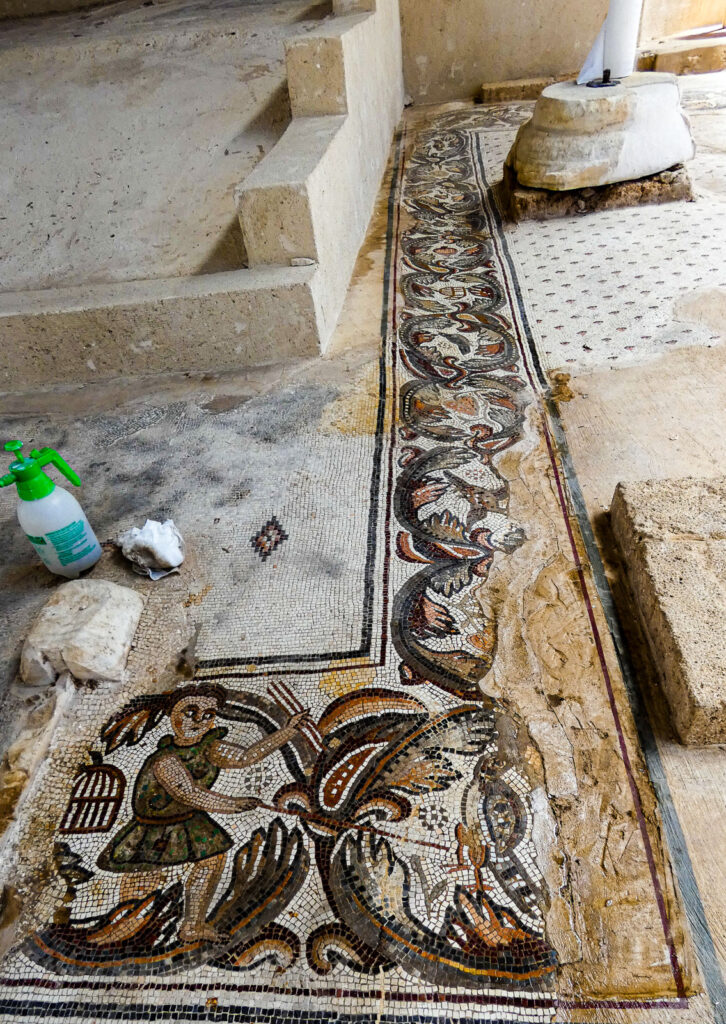
The mosaic: technique and decoration
The mosaic is of high technical quality for its region and period. The tesserae are of local limestone, 8 × 8 mm. The faces, hands and feet of the figures are made of smaller tesserae, 6 × 5 mm. Pottery sherds were also set for yellow, and glass cubes for blue and green. The palette includes black, grey, brown, red, pink, yellow, ochre, green, blue and a little turquoise, each colour in a range of shades.
At the centre of the hall is a large circle with an open red rose at its centre. Around it, colourful concentric rays form a pattern of folded fan pleats in depth, through precise play of light and shade. A meander border around the circle also creates a sense of depth. Around the circle are scattered red rosebuds, set within a pattern of semicircular scales of white tesserae that covers the entire hall. The apses were paved with geometric patterns. A colourful band of medallions, 60 cm wide, surrounds the aisles. 87 medallions survive, with a total length of 57 m. Of the 11 human figures in the mosaic, only the bird-catcher is clothed.
The destruction
The church was destroyed in a fierce fire. The roof beams burned and fell together with bronze ornaments that had hung from chains, and the marble shattered and crumbled. Fire and smoke left white and black stains on the floor, and the lead in the joints between the column drums melted. In the south aisle, near the apse, seven large storage jars and fragments of plates were found. It appears that people sought refuge in the church as the enemy approached. The destruction is dated to the Persian conquest of 614. A similar fate befell the churches at Evron and Shavei Zion, which were also destroyed by fire.
The bird-hunting scene
In front of the bema, at its southern corner, a professional bird-catcher in a green tunic holds four limed sticks. Facing him, in the adjacent medallion, stands a Eurasian sparrowhawk. This is the only known depiction of bird-catching with limed sticks in the mosaics of the Land of Israel.
The sparrowhawk was a motionless stuffed decoy, which served the bird-catcher as an aid in the hunt.
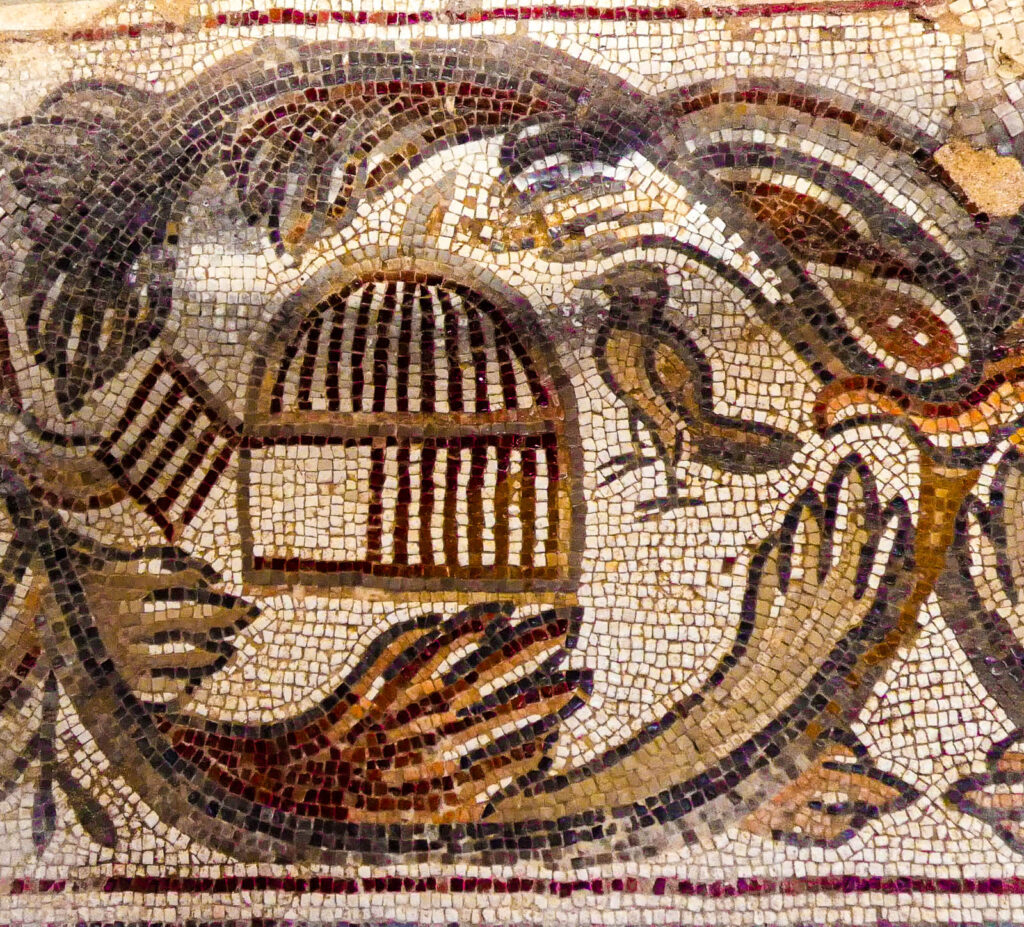
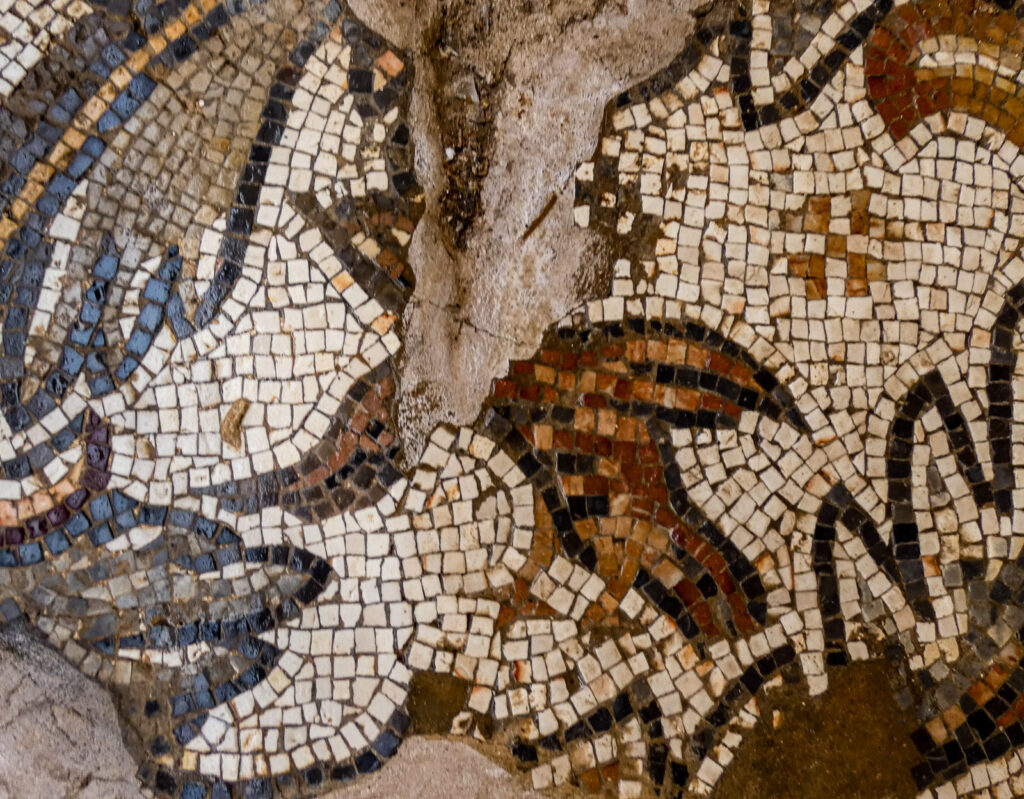
A female common blackbird and a hooded crow are shown facing open, empty cages, turned toward their openings, a moment before capture.
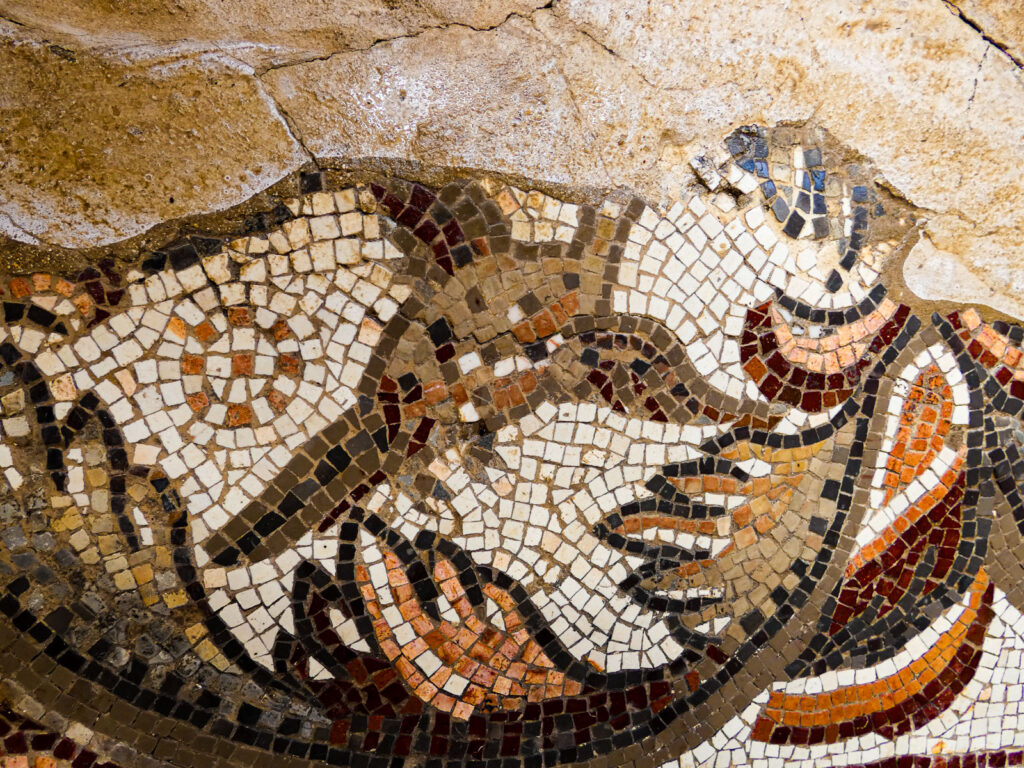
Two rock doves and a female Eurasian blackcap are shown in flight, startled and escaping. This is the only depiction of birds in flight in the mosaics of the Land of Israel. The Eurasian blackcap, too, is known in the mosaics of the Land of Israel only from Nahariya.
The species in the mosaic
Mammals: lion, tiger, leopard, Syrian brown bear, mountain gazelle, Persian fallow deer, hare, zebu cattle, fat-tailed sheep, goat, horse and Canaan dog.
Birds: Indian peafowl, common pheasant, domestic chicken, chukar partridge, black francolin, rock dove, common blackbird, hooded crow, Eurasian blackcap, common crane and Eurasian sparrowhawk.
Invertebrates: shrimp.
Plants: grapevine, pomegranate, fig, citron, watermelon, rose and taro (Colocasia antiquorum).
More photographs of the mosaic and details on visiting the site appear in the post The Byzantine Church Mosaic at Nahariya on the Anat Tour website.
Main Sources
- Avital, A. 2026. The Fowler, the Sparrowhawk and the Birds: Ancient Methods for Controlling and Exploiting Pest Birds in the Byzantine Church Mosaic at Nahariya. Preprint, Zenodo. doi:10.5281/zenodo.24040177
- Dauphin, C. and Edelstein, G. 1984. L’église byzantine de Nahariya (Israël): étude archéologique (Byzantina Mnēmeia 5). Thessaloniki: Centre for Byzantine Research.
- Dauphin, C. and Edelstein, G. 1993. The Byzantine Church at Nahariya. In: Y. Tsafrir (ed.), Ancient Churches Revealed. Jerusalem: Israel Exploration Society: 49–53.
- Edelstein, G. and Dauphin, C. 1986. The Byzantine Church on Givat Katznelson at Nahariya. In: M. Yedaya (ed.), The Western Galilee Antiquities. Tel Aviv: 387–392 [in Hebrew].
- Madden, A. M. 2014. Corpus of Byzantine Church Mosaic Pavements from Israel and the Palestinian Territories (Colloquia Antiqua 13). Leuven: Peeters.
- Ovadiah, A. and Gomez de Silva, C. 1981. Supplementum to the Corpus of the Byzantine Churches in the Holy Land, Part I. Levant 13: 200–261.