The Place of Nilotic Motifs in the Book
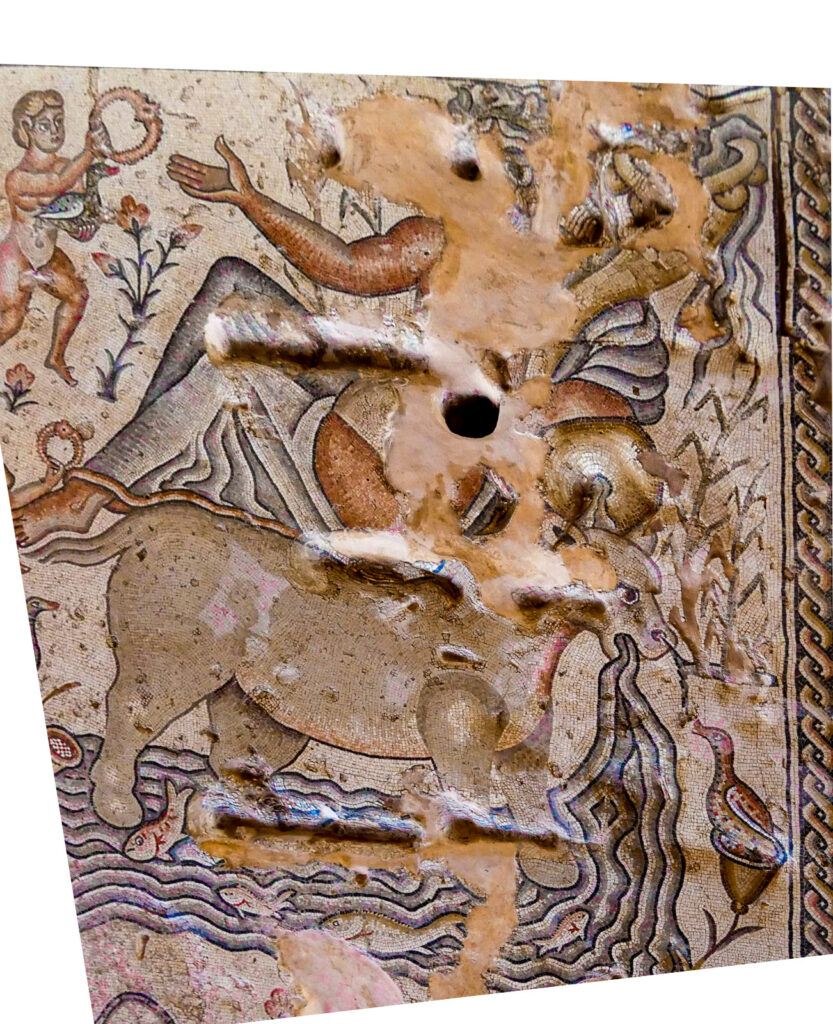
The mosaics of the Land of Israel from the Late Roman and Byzantine periods reflect the world of the people of their time. The animals, plants, crops, buildings, tools and landscapes record the environment, economy, agriculture, culture and art of the period, and are a historical source of the first order for understanding the reality of the Land of Israel.
The Nilotic scenes form a distinctive group within this body of material. They depict the world of the Nile: its waterscapes, vegetation, animals, buildings, boats and water installations, all characteristic of Egypt. Identifying and interpreting them therefore requires a clear distinction between the local reality of the Land of Israel and the geographical, ecological and cultural reality of the land of the Nile.
For many years the Nilotic scenes of the Land of Israel were seen as the expression of an artistic tradition that originated in Egypt. A review of the archaeological record known today shows that the publications from Egypt include only a handful of mosaics depicting the world of the Nile, most of them fragments or small panels showing a single animal, plant or figure. The mosaic from Thmuis in the Delta, which presents a broad Nilotic scene, differs in its composition, subjects and character from the Nilotic mosaics of the Land of Israel. The published material does not contain a corpus of Nilotic mosaics that could have served as a source for the mosaics of the Land of Israel.
In the Land of Israel, varied Nilotic compositions developed, differing from one another in their animals, vegetation, buildings, water installations and overall composition. No two mosaics are alike. Among them appear species whose range lies outside the Land of Israel, including the crowned crane and the Barbary partridge. They also include the common pochard and the great cormorant, which pass through or winter in Israel during migration and appear in the mosaics of the Land of Israel only in a Nilotic context.
The choice of species reflects the living environment of the land of the Nile, and each site chose its motifs independently. The Nilotic mosaics of the Land of Israel attest to the artisans’ direct visual knowledge of the Nile world, and depict Nilotic reality as it was observed and known to the artisans and to the patrons of the mosaics. Each motif, familiar as it is, is designed in an original and independent way in every mosaic.
The connections between the Land of Israel and Egypt were continuous throughout the Hellenistic, Roman and Byzantine periods. Sea routes linked Alexandria with the harbours of Gaza, Ashkelon, Jaffa and Caesarea. Merchants, officials, soldiers, pilgrims, clergy, artisans and craftsmen moved between the two regions, and with them travelled goods, animals, plants, knowledge and artistic influences. Trading voyages to Egypt were part of everyday life for centuries, and the information in the mosaics complements what is known from the written sources.
The Nilotic scenes present the landscapes of Egypt, its festivals, its fauna and flora, and the cycle of water and life of the Nile. They showed viewers one of the great centres of the ancient world: its landscapes, animals, vegetation, buildings and ways of life along the river. In the Byzantine period, Nilotic scenes were also laid in churches and monasteries.
Distinguishing between a Nilotic scene and a depiction of local reality is a basic step in correctly identifying the animals, plants and buildings in the mosaics of the Land of Israel. The first part of this page presents the features of Nilotic scenes and how they are identified. The second part presents evidence of trade and luxury connections with Egypt: animals imported through Egypt, and landscapes that the owners of the houses saw on their journeys up the Nile. The page serves as the basis for all the Nilotic motifs discussed later in the book.
The Nilotic Scene
In the Land of Israel, Nilotic scenes appear in villas and wealthy houses, and in churches and monasteries. They depict the water world of the land of the Nile through a combination of aquatic plants, animals, buildings, boats and water installations, which together create a broad picture of the natural and human environment along the river.
A Nilotic scene is identified by the combined presence of several features. The most prominent of the aquatic plants is the sacred lotus, characteristic of the marshes, lakes and branches of the Nile. The lotus does not grow wild in Israel, and it is therefore one of the clearest markers of the Nile landscape in the mosaics.
The fauna consists mainly of waterbirds and marsh birds, among them the Egyptian goose, ducks, herons, storks, cormorants, the red-breasted goose, the Barbary partridge, the common pochard, stints and the crowned crane. The birds are presented in the chapter Birds in a Nilotic Context. Alongside the birds appear African mammals, among them the hippopotamus, on which the Nile god rides at Sepphoris and in the House of Leontis at Beth She’an, and the water snakes of the Nile. The Nile Festival Building at Sepphoris has the richest assemblage of African animals, including zebu cattle and other species characteristic of Egypt and Africa.
Buildings and water installations join the fauna: Nilometers, towers, gates, walls, temples, boats and landing places. Some of the mosaics also bear inscriptions naming Egypt, Alexandria or the festivals of the Nile flood, which explicitly identify the geographical setting of the scene.
The mosaic of the Nile Festival Building at Sepphoris is the richest and most detailed Nilotic composition found in the Land of Israel. It depicts the festivals of the Nile flood, the water systems, the Nile god, the goddess Euthenia (Εὐθηνία), a wide range of animals, buildings, boats and scenes of daily life. The mosaic is a route map of the entry into Egypt and of the course of the Nile, and it is presented on the page The Nile Festival Mosaic at Sepphoris.
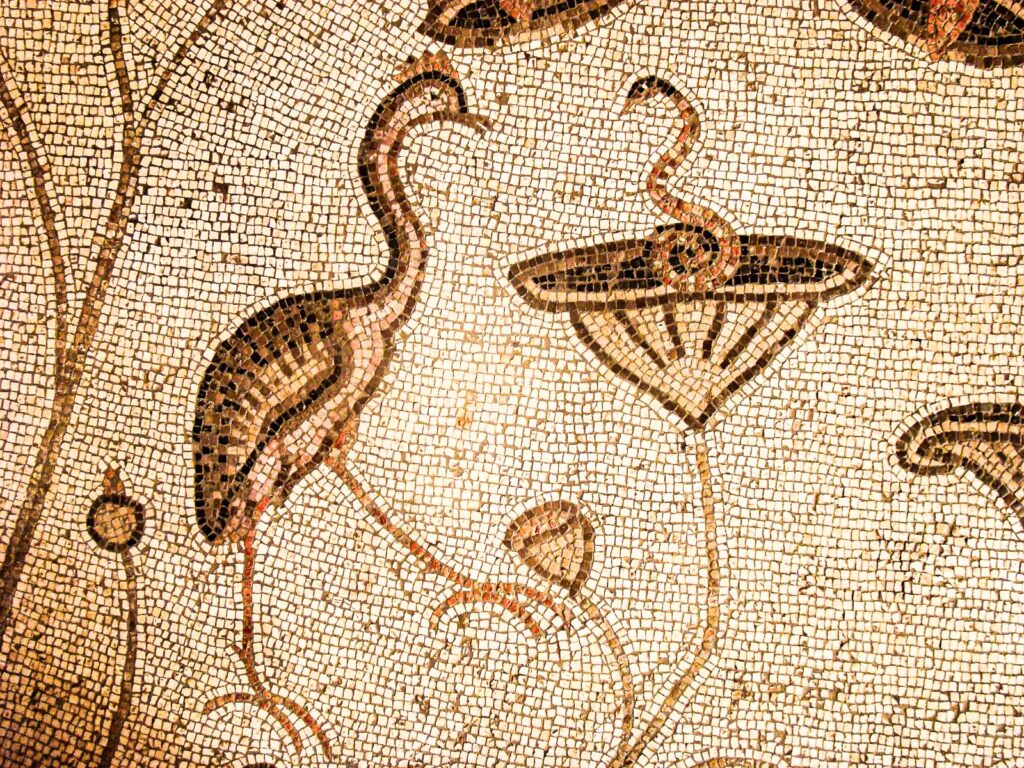
The church mosaic at Tabgha (Ein Sheva) contains the richest Nilotic panel in Israel in terms of its birds, together with lotuses, a tower for measuring the water level, water snakes and aquatic plants.
The combination of these features in a single mosaic is the basis for identifying a scene as Nilotic and for interpreting it.
Recording the Land of the Nile
The Nilotic mosaics bring together on a single surface animals, birds, buildings, water installations and plants that were observed at different places along the Nile, and together they create a broad picture of the living environment along the river.
Each composition was built independently, and the mosaics differ greatly from one another. Some show the marshland world of the Delta, others the landscapes of Upper Egypt, and others also include animals of the Upper Nile and of the African savannas. Each mosaic presents a unique combination of animals, plants, buildings and water installations, and preserves a different selection of landscapes and sights, according to the choice of the artisans and of the owners of the buildings.
The Nile mosaic from Palestrina in Italy presents a general view of the land of the Nile, from the Delta to Ethiopia, with captions naming the animals. It is presented on the page The Nile Mosaic from Palestrina.
In Villas and Wealthy Houses
Nilotic scenes already appeared in the Roman period in the decoration of luxurious villas and wealthy houses throughout the Roman Empire. They adorned reception halls, triclinia and guest rooms, and combined a rich world of water, vegetation, animals, hunting, boating and buildings of the land of the Nile.
In the Land of Israel this tradition is documented at Sepphoris, in the villa at Emmaus (near Latrun) and in the villa at el-Maqerqash at Beit Guvrin. In the House of Leontis at Beth She’an it continues into the Byzantine period, in a wealthy house. Each presents a different combination of Nilotic motifs: waterbirds, hippopotami, zebu cattle, lotuses, Nilometers, buildings, boats, geographical inscriptions and hunting scenes.
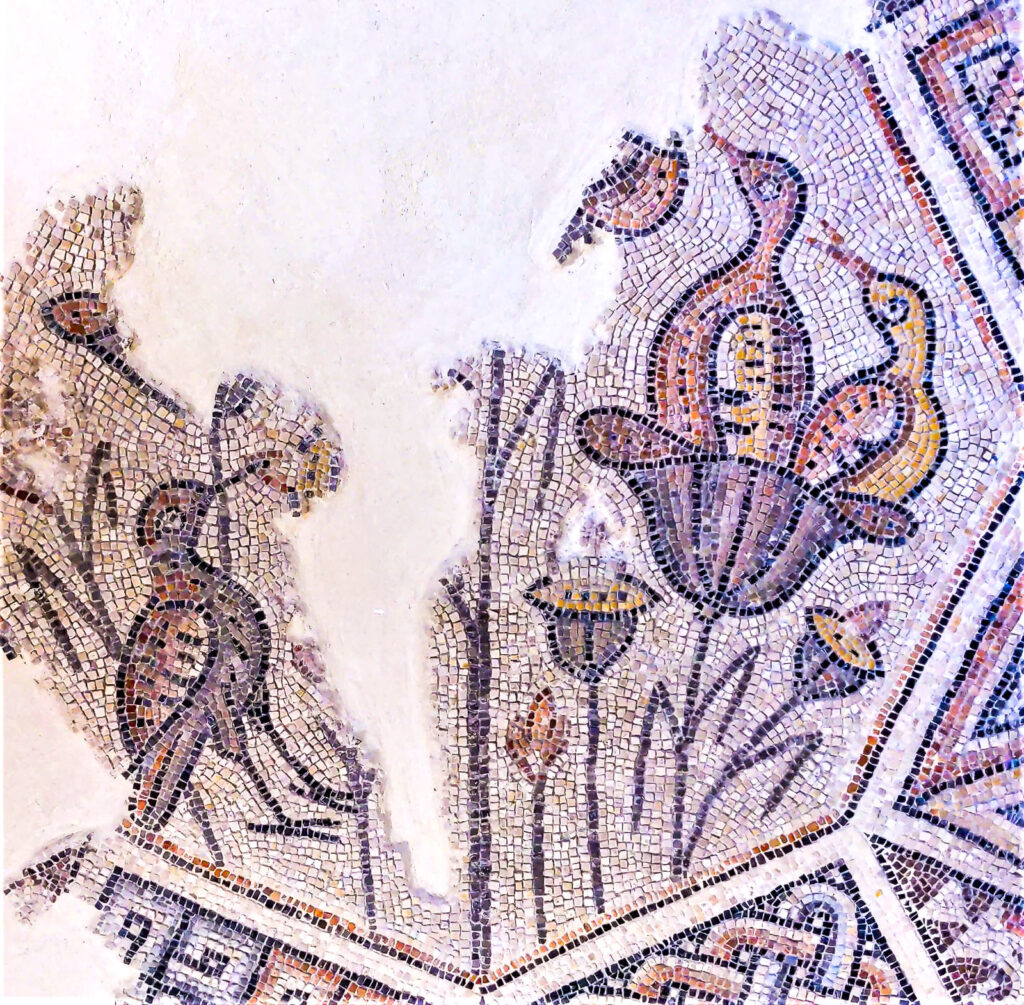
Each villa presents an independent selection of animals, plants and buildings, according to the world of the owners and the decorative programme of the building. The mosaics preserve different sections of the Nile world, from the Delta and Alexandria to Upper Egypt and the Upper Nile.
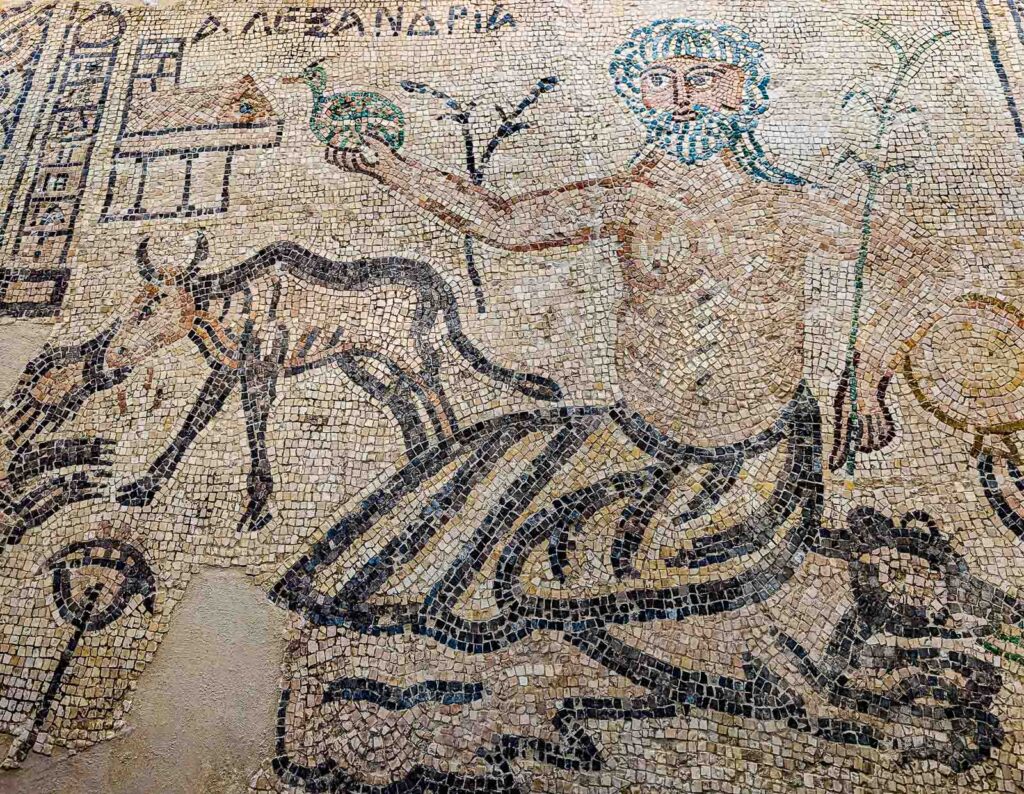
At the centre of these compositions stand the waterscapes, abundance and nature of the land of the Nile, alongside evidence of journeys, trade and direct acquaintance with Egypt. On this artistic foundation the Nilotic compositions of the Byzantine churches also developed, adapted to their architectural space.
In Churches and Monasteries
In the Byzantine period, Nilotic scenes were also laid in churches, chapels and monasteries in the Land of Israel: at Tabgha, Kfar Kama, Hadid, the Monastery of Martyrius at Ma’ale Adumim, Midras, Beit Loya and Beit Guvrin. The birds, mammals, lotuses, buildings and water installations were integrated into the architectural space of the churches, alongside geometric, floral and figurative mosaics.
At some sites there are geographical inscriptions such as “Alexandria” or “Egypt”, and at others the Nilotic motifs appear without an inscription. The state of preservation of the mosaics, and the partial publication of some sites, do not always allow us to determine whether such inscriptions originally existed.
Each site combined different elements of the Nile world, according to its character, its decorative programme and the place of the scene within the building.
Tabgha: The Sea of Galilee and the Land of the Nile
The Church of the Multiplication of the Loaves and Fishes at Ein Sheva (Tabgha) presents one of the richest and most detailed Nilotic scenes in the Land of Israel. Besides the waterbirds, lotuses and buildings, it depicts a tower for measuring the water level, incised with graduation marks and Greek letters.
The northern shore of the Sea of Galilee lies about 200 metres below sea level. The hot climate, the springs, the delta of the Jordan in the Bethsaida Valley (the Batiha) and the Ginnosar Valley together create a landscape of marshes, aquatic plants and rich fish life, with species of African origin such as the Christ’s thorn jujube, papyrus, the Galilee tilapia and the African catfish. These landscapes resemble those of the Nile, and people at the time noticed the resemblance. Josephus reports that some thought the spring which the locals call Capharnaum to be a vein of the Nile, because it breeds a fish similar to the coracinus of the lake at Alexandria (Jewish War 3.519–520). This is the spring of Ein Iyov at Tabgha.
Above the spring of Ein Iyov a hollow basalt water tower was built in the Roman period. The tower raised the level of the spring water to the height of an irrigation channel that led westwards to the Ginnosar Valley, and a system of graduation marks for measuring the water level was installed inside it. It is likely that the water-lifting works were built on the model of the waterworks and Nilometers of Egypt, which the builders knew at first hand.
In the mosaic, the artisans combined their direct knowledge of the Nilometers of Egypt with the local water system. The idea that the Sea of Galilee was connected to the Nile placed its northern shore alongside the mighty system of the Nile, and therefore “Alexandria” or “Egypt” was not written in the mosaic, as at Sepphoris, the House of Leontis and Hadid, and the whole mosaic is Nilotic. Its birds, among them the crowned crane facing an Egyptian cobra and a tame mongoose, are presented in the chapter Birds in a Nilotic Context.
Evidence of Trade and Luxury Connections with Egypt
In the wealthy houses of the Late Roman period, other expressions of the connections with Egypt appear: animals imported through Egypt, and landscapes that the owners saw on their journeys up the Nile. These express the owners’ life of plenty, their luxury journeys and luxury imports. In this period the connections with Egypt were mainly trade connections by sea, and it is likely that the owners of the houses at Ein Yael and Lod sailed to Egypt from the port of Jaffa.
Ein Yael
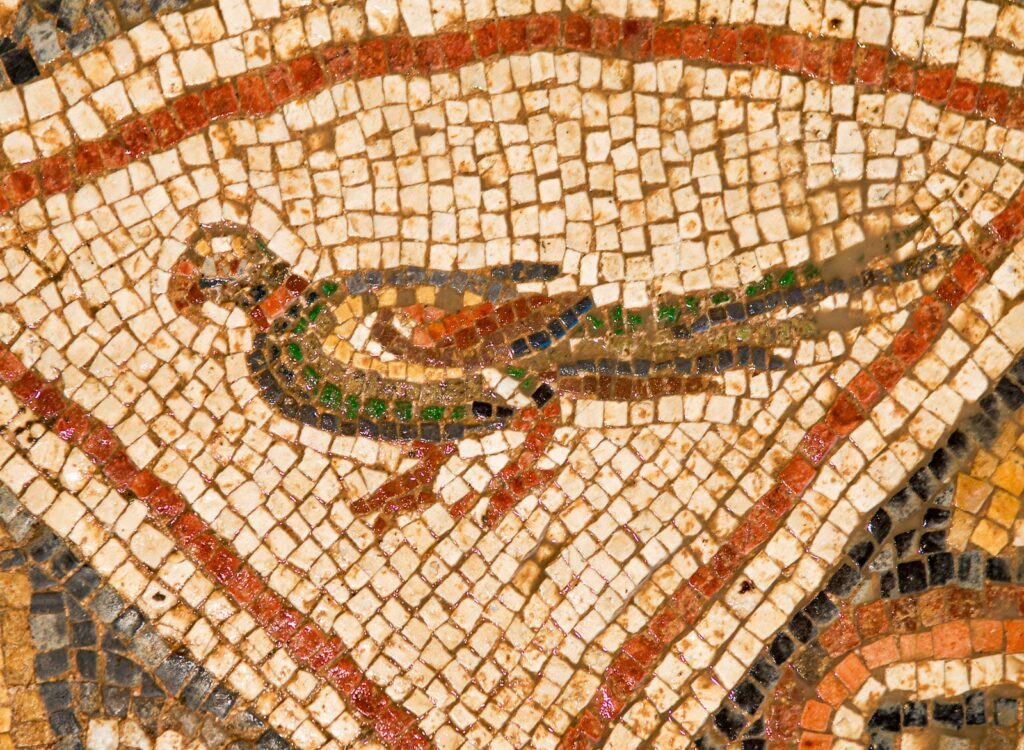
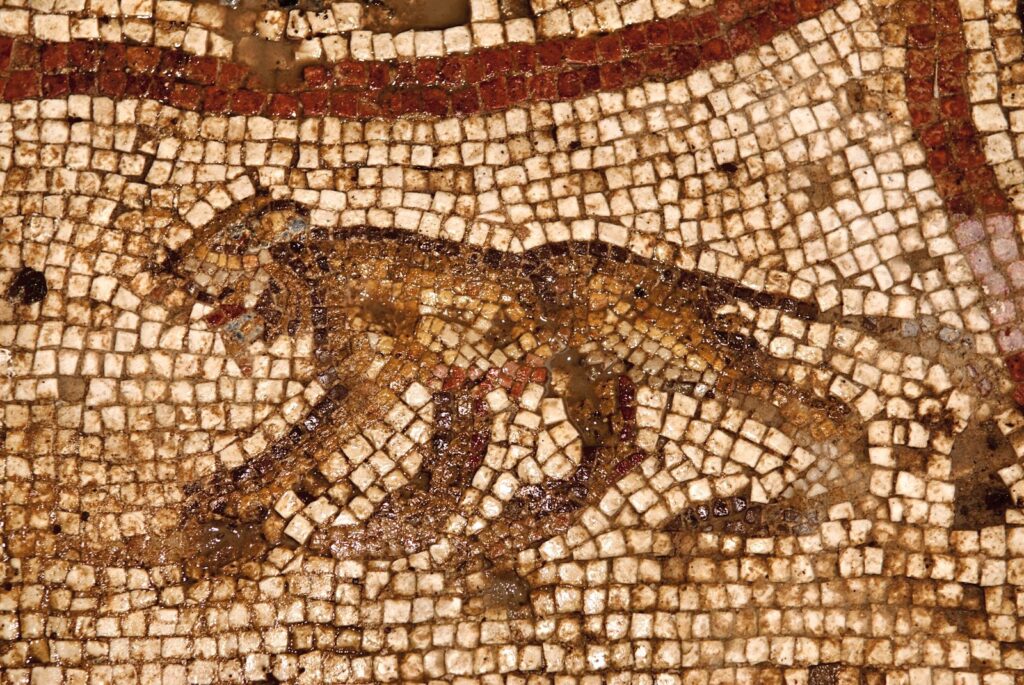
The Roman villa at Ein Yael, in Nahal Refa’im in south-western Jerusalem, depicts an Alexandrine parakeet and a bonnet macaque. Both species originate in India. The bonnet macaque, from southern India, is identified by the cap of hair above the forehead, the tail almost as long as the body, and the exposed teeth and red gums. It is the only monkey in the mosaics of the Land of Israel. Both species probably arrived along the trade route with India, through the Red Sea and Egypt. The identification marks of the parakeet are set out in the section on the Alexandrine parakeet.
Lod
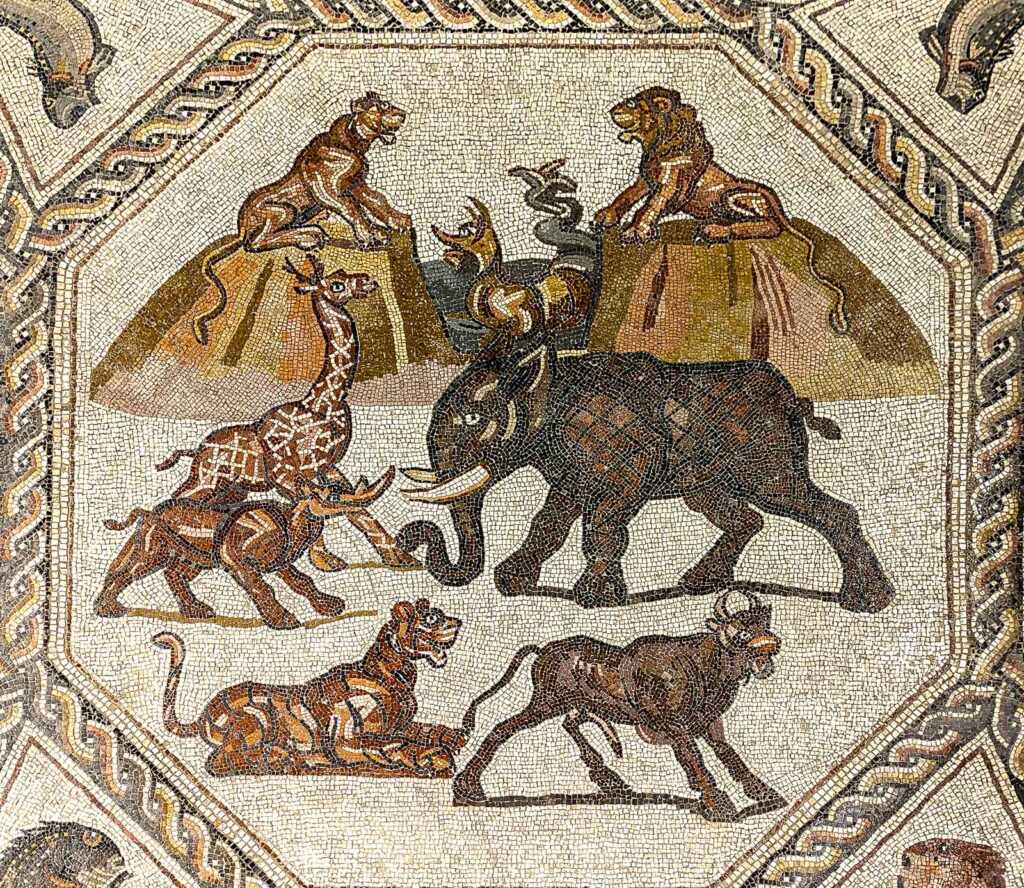
The villa at Lod depicts the large mammals of the African savanna, the animals that the owners saw on their journey up the Nile. The savannas begin in the region where the White and Blue Nile meet, where Khartoum stands today. Pliny the Elder, citing the reports of the expedition sent in the reign of Nero, writes that around Meroe, about 200 km north of Khartoum, the grass becomes greener, woodland begins, and tracks of rhinoceroses and elephants were seen (Natural History 6.184–185). The Lod mosaic is the only record of the savanna landscapes themselves in the mosaics of the Land of Israel.
The villa also depicts an Alexandrine parakeet, with a red collar and red on the wing, and the mosaic includes a maritime scene with ships. The mammals and birds of the house are presented in the article Exceptional Mammals and Birds from the Roman Mansion Mosaic in Lod.
Sepphoris: The Agora Mosaic
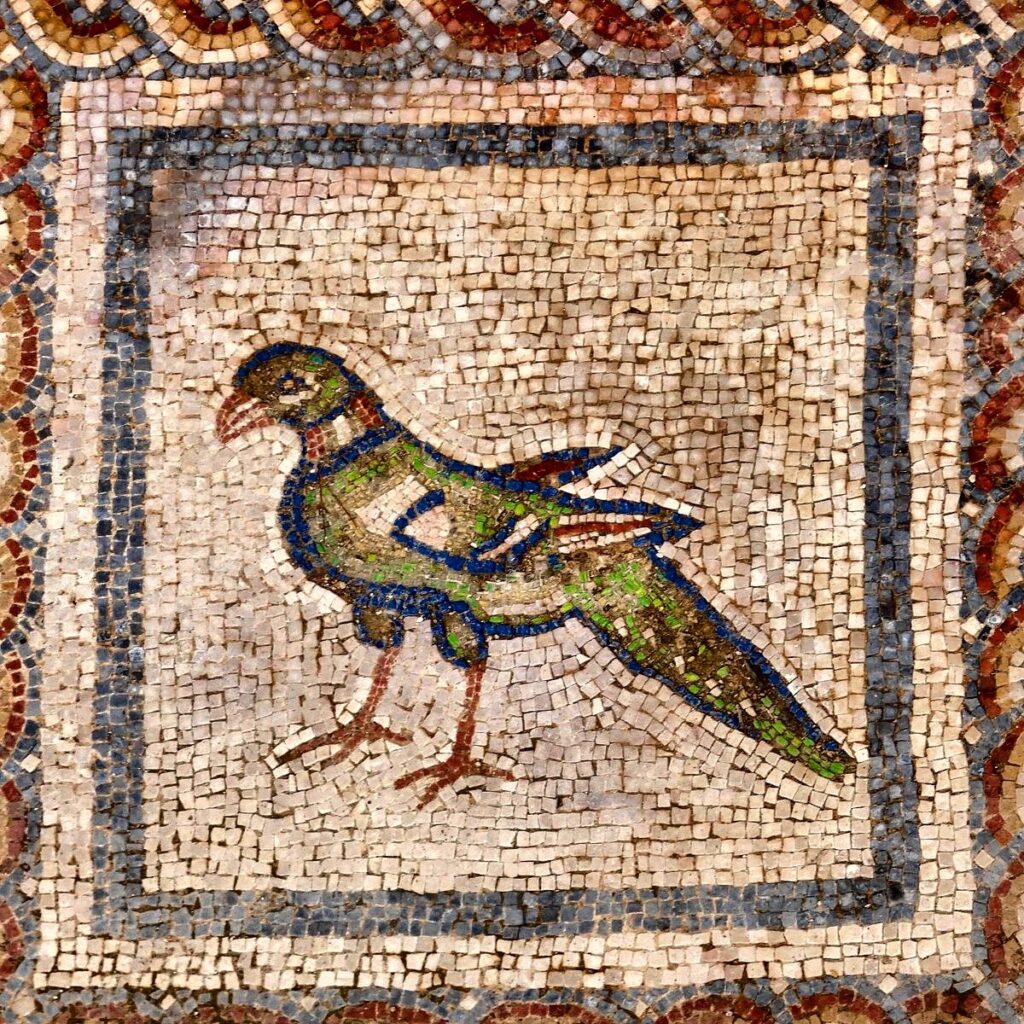
The Agora mosaic at Sepphoris (the “Double Axe”), from the Late Roman period, depicts an Alexandrine parakeet, and beside it a Nilotic landscape: a fisherman, fish, a Eurasian teal on a lotus cup, and houses and temples beyond the walls.
The three sites with the Alexandrine parakeet, Ein Yael, Lod and the Agora at Sepphoris, are wealthy houses of the Late Roman period, and in all of them it is depicted without a ribbon on the neck. In these houses the parakeets attest to imports through Egypt. The smaller rose-ringed parakeets appear only in mosaics of the Byzantine period, and it seems that in this period their breeding became more widespread and commercial.
Beit Loya
The church at Beit Loya, in the Judean Shephelah, depicts sycamore figs in containers. The sycamore, a tree of African origin grown in Egypt since ancient times, was cultivated in the Shephelah, and its cultivation also attests to the connections with Egypt. The mosaic also includes characteristic expressions of the Nile: lotus cups, an Egyptian goose beside lotus flowers, ducks, a common crane and a white stork.
Summary
The Nilotic motifs in the mosaics of the Land of Israel record the water world of the land of the Nile through animals, plants, buildings and water installations, depicted with great accuracy and in a wide variety of combinations. Alongside them, animals imported through Egypt, and the savanna landscapes that the owners of the houses saw up the Nile, attest to luxury journeys and to trade. Together they reflect the continuous connections between Egypt and the Land of Israel and the movement of people, goods and knowledge between the two regions, and they complement what is known from the written sources.
Main Sources
Ancient sources
- Josephus, Jewish War 3.519–520.
- Pliny the Elder, Natural History 6.184–185.
Modern research
- Avital, A. 2014. Representation of Crops and Agricultural Tools in Late Roman and Byzantine Mosaics of the Land of Israel. PhD dissertation, Bar-Ilan University (Hebrew).
- Avital, A. 2022. Illustrations of Birds in Mosaics from the Byzantine Period in Judea, Samaria and the Sharon. Judea and Samaria Research Studies 31(2): 183–219 (Hebrew; revised English edition, 2026). https://doi.org/10.26351/JSRS/31-2/2
- Avital, A. 2024. Exceptional Mammals and Birds from the Roman Mansion Mosaic in Lod. Lod “Diospolis – City of God” 10: 99–122 (Hebrew; revised English edition, 2026).
- Avital, A. 2026. Three Gateways to Egypt: The Nile Festival Mosaic at Sepphoris as a Geographical and Hodological Route Map. Preprint, Zenodo. https://doi.org/10.5281/zenodo.23453633
- Loffreda, S. 1970. Scavi di et-Tabgha: Relazione finale della campagna di scavi 25 marzo – 20 giugno 1969. Jerusalem: Franciscan Printing Press.
- Madden, A. M. 2014. Corpus of Byzantine Church Mosaic Pavements from Israel and the Palestinian Territories. Leuven: Peeters.
- Weiss, Z. and Talgam, R. 2002. “The Nile Festival Building and Its Mosaics: Mythological Representations in Early Byzantine Sepphoris.” In The Roman and Byzantine Near East 3, edited by J. H. Humphrey, 55–90. JRA Supplementary Series 49. Portsmouth, RI.
- Zori, N. 1966. “The House of Kyrios Leontis at Beth Shean.” Israel Exploration Journal 16: 123–134.