This chapter deals with the resident birds depicted in the mosaics of the Land of Israel, and brings together resident species from the orders of hoopoes, pigeons and doves, ostriches, cranes and rails, songbirds and galliform birds. The orders are discussed in the alphabetical order of their Hebrew names.
Alongside the systematic classification, the birds are surveyed according to their natural and ecological behaviour, their economic and aesthetic value, and their frequency in the surroundings of the mosaic site and in the mosaic depictions themselves. Their natural habitats are also examined, together with the relationship between their natural distribution and the surroundings of the mosaic site, and their uses by people in animal husbandry, in agriculture and in the economy of the period.
The research shows that species which were hunted, kept in captivity, or fully or partly domesticated were of great importance. It further shows that the selection of species depicted in the mosaics reflects their economic value for the inhabitants of the site, and that the owners of the buildings displayed through them the wealth and prosperity they enjoyed thanks to their blessed and varied agriculture, their agricultural and economic capabilities, and the objects of their pride.
Hoopoes
Eurasian Hoopoe

The Eurasian Hoopoe belongs to the order of hoopoes. It is a medium-sized bird, resident in the local landscape and familiar around farmsteads and agricultural land. It is easily identified by its upright build, the colours of its plumage, its fan-shaped crest and its long, curved bill, hence its striking visual appeal.
In the mosaics of the Land of Israel the hoopoe appears in 2 mosaics only: in the Chapel of St John the Baptist in Jerusalem and in the Lady Mary Monastery at Beth She’an in Lower Galilee, both Christian buildings. It is therefore not among the birds most frequently represented in the mosaics. Nevertheless, both depictions preserve a clear and precise rendering of its distinctive features, evidence of the mosaic makers’ direct familiarity with the species.

To the best of my knowledge, these are the only two depictions of the hoopoe in mosaics of the Late Roman and Byzantine periods. Its rarity may stem from the preference of the mosaic makers for species more closely connected with the household economy and with the abundance and fertility of local agriculture. When small resident birds such as the hoopoe do appear, they are usually set within depictions of gardens, vineyards and natural landscapes.
Although we have no direct evidence that the hoopoe was not hunted for food, it appears not to have been a sought-after game bird. In Jewish tradition it is among the birds forbidden as food, and Pliny the Elder describes it as feeding on filth, a description that may have added to the aversion to it as a source of food. To this may be added the pungent, foul smell of its nests, caused by the defensive secretions of the female and the nestlings. On the other hand, its distinctive colouring, fan-shaped crest and long, curved bill gave it a striking appearance, which contributed to the choice to depict it, although its economic importance was probably limited compared with other birds.
Pigeons and Doves (Columbiformes)

Birds of the order Columbiformes are represented in the mosaics of the Land of Israel frequently and with a relatively high level of identifiability, thanks to their medium body size and their conspicuous morphological features. The order is included here among the resident birds because its species are closely bound up with the human environment, the built-up area and everyday life. The species identified in the mosaics include the Rock Dove, the most common of the Columbiformes, owing to its abundance in the wild and to its being the main species raised in dovecotes for human needs; after it, less frequently, appear the Laughing Dove, the Eurasian Collared Dove and the Pin-tailed Sandgrouse of the sandgrouse family. All three species are widespread in the Land of Israel in a variety of habitats, especially near settlements, agricultural land and environments disturbed by people, so it is no wonder that they are well represented in mosaic art too.
Columbiform birds are depicted in the mosaics close to garden plants and fruit trees, sometimes gathering food, and sometimes in scenes that reflect their place in animal husbandry and everyday life. Body size, proportions, standing postures, tail structure, wing shape, the colours of the legs and bill, and plumage patterns allow identification to species level in many cases. This accuracy shows the mosaic makers’ direct and thorough familiarity with the birds that lived around them, and is further evidence of the realistic character of many of the bird depictions in the mosaics of the Land of Israel.
Rock Dove

The Rock Dove is the most common of the Columbiformes in the mosaics of the Land of Israel, and the 3rd most common of all the birds, after the peafowl and the partridge. It has been identified at 21 mosaic sites throughout the country, in the Golan, Upper and Lower Galilee, Mount Carmel, the Judaean Shephelah, Jerusalem, the Hebron Hills and the western Negev, about half of them in Lower Galilee. 17 of the mosaics adorned Christian buildings, 3 Roman buildings and one a synagogue. This wide geographical spread corresponds well to its natural distribution in the Land of Israel and to its closeness to human settlements, cliffs, buildings and farmland.
Alongside the wild populations of the Rock Dove, which continued to nest on cliffs, in buildings and in natural habitats throughout the Land of Israel, the Roman and Byzantine world also developed the intensive raising of doves in dovecotes (columbaria). Within this framework the doves underwent domestication, selective breeding and the selection of breeds for meat, eggs, trade and keeping for pleasure. The domestication process did not replace the wild populations but existed alongside them, so that in the Land of Israel wild doves and doves raised by people lived side by side. Varro and Columella describe in detail the building of dovecotes and the raising, breeding and fattening of doves. According to them, a single dovecote could hold up to five thousand doves, and there was even a dedicated keeper responsible for looking after them and maintaining the dovecote.
Besides their economic value, doves were also kept as pets. Pliny describes the Romans’ great love of doves, to the point of building splendid dovecotes on the roofs of houses and cultivating choice breeds. Martial and funerary inscriptions show that people sometimes formed emotional bonds with them. Varro and Columella note that a pair of choice doves, intended to be kept as pets and ornamental birds, sold for a thousand sesterces, and sometimes even four thousand sesterces — exceptionally high sums, which might equal the price of a slave in the Roman world. Doves were also used to carry messages over long distances as carrier pigeons, further evidence of how well they could be trained and of a thorough knowledge of their behaviour.
The Be’er Shema mosaic shows a pair of doves nesting in an amphora, a depiction that reflects the creation of nesting conditions and the use of doves for meat and eggs. This depiction joins the archaeological and literary evidence for the raising of doves as part of the agricultural economy of the period.
The Rock Dove appears in the mosaics in geometric medallions, among vine scrolls, in garden scenes and in pastoral depictions of the surrounding landscape and of garden courtyards. Its body size, colours, wing and tail structure and plumage patterns allow identification to species level in many cases, and attest to the mosaic makers’ direct familiarity with the bird in its natural surroundings.
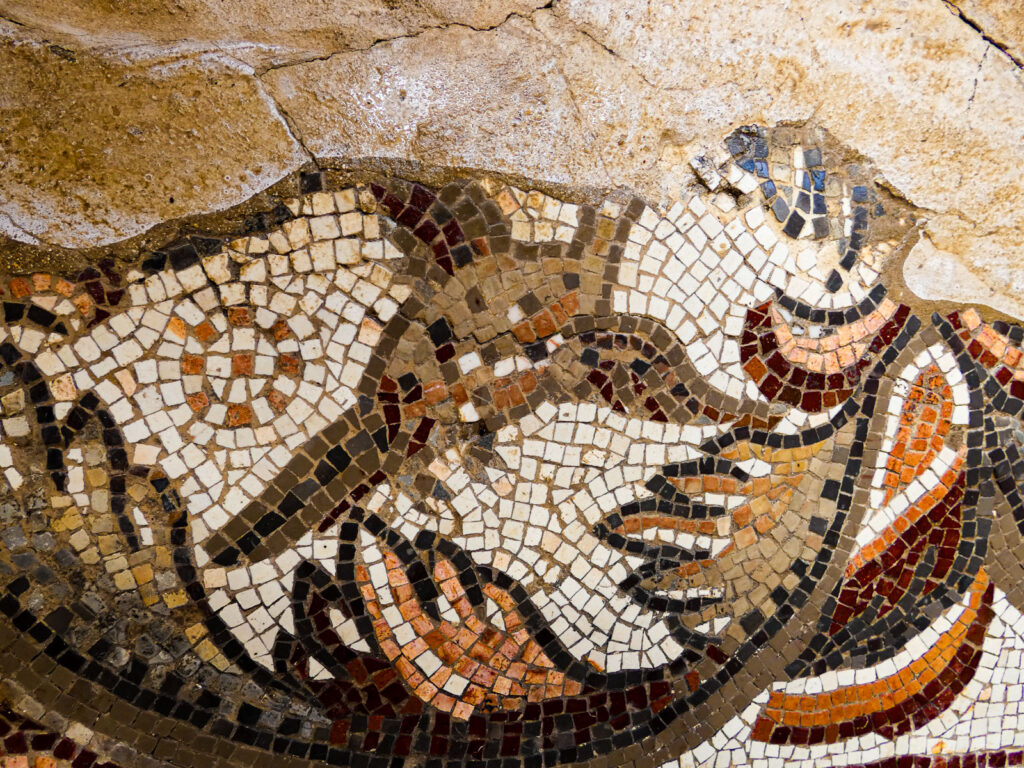
An especially distinctive depiction appears in the mosaic of the Nahariya church, which shows two Rock Doves in flight, startled and flying off during the hunt. The scene shows a hunter holding a limed stick, with three more limed sticks in his other hand. Facing him stands a Eurasian Sparrowhawk, a motionless stuffed bird that served the hunters as an aid in catching birds, and behind it an open cage used for catching birds. This is the only depiction of this hunting method in the mosaics of the Land of Israel, and the only mosaic in the Land of Israel that shows birds in flight. It offers a unique glimpse of practical aspects of everyday life and of the food economy in the Byzantine period.
Taken together, the depictions reflect the abundance of the Rock Dove in the landscape of the country, its closeness to the human environment and the variety of uses made of it. The mosaics show that the dove was part of the natural landscape and a central element in the world of agriculture, food and everyday life of the country’s inhabitants in the Late Roman and Byzantine periods. The combined archaeological evidence, mosaic depictions and Roman sources show that doves were among the most important birds in the household economy of antiquity. They were a source of meat and eggs, were raised in dovecotes on a large scale, were kept as pets, were used to carry messages and had high commercial value, all without losing their status as resident wild birds common in the fauna of the Land of Israel.
Laughing Dove

The Laughing Dove is a small dove of the order Columbiformes, a resident bird common in the human environment. It appears in 11 mosaics, and is the second most common of the Columbiformes, after the Rock Dove. Its distribution in the record is wide, in Lower Galilee, the Judaean Shephelah, Jerusalem and the western Negev, mostly in Lower Galilee. 5 of the mosaics adorned Christian buildings, 4 Roman buildings and 2 synagogues.
The Laughing Dove is identified by its size, smaller than the Rock Dove, its slender body and its relatively long tail. Its body is pinkish-brown, and on the front of its neck it has a rufous patch speckled with black. Most of these features can be seen in the high-quality mosaics, for example in the Chapel of St John the Baptist in Jerusalem.
The Laughing Dove nests in trees, bushes and buildings, and gathers seeds on the ground in courtyards, gardens and fields. Its closeness to houses and to the farm makes it one of the most familiar birds of the settled landscape, and its many appearances in mosaics of all sectors match its everyday presence around the buildings. The Laughing Dove may have been hunted for food, like other doves, and it may also have been kept in captivity alongside Rock Doves.
Eurasian Collared Dove

The Eurasian Collared Dove is a medium-sized dove of the order Columbiformes. It has been identified in one mosaic only, in the Lady Mary Monastery at Beth She’an in Lower Galilee, where it is set in a geometric medallion among many other mammals and birds.
The Eurasian Collared Dove is identified by its uniform pale grey colouring and by a black half-collar on the nape, a distinctive feature that no other dove in the country has. In the Beth She’an mosaic the half-collar is clearly rendered, and the identification is therefore to species level.
The Eurasian Collared Dove lives near settlements, in gardens and orchards, and nests in trees. Today it is very common in Israel. Its appearance in the Beth She’an mosaic attests to its presence in the Beth She’an Valley as early as the Byzantine period.
Pin-tailed Sandgrouse

The Pin-tailed Sandgrouse is a ground bird of the sandgrouse family, within the order Columbiformes. It is identified in 2 mosaics from the western Negev: in the synagogue at Ma’on-Nirim and in the Shellal church. The Ma’on-Nirim mosaic shows a pair of sandgrouse, a male and a female, in a vine-scroll medallion. In the Shellal mosaic a sandgrouse apparently appears in a vine medallion and also inside a wooden cage. However, the mosaic’s location in a museum in Canberra, the capital of Australia, and the lack of good-quality photographs do not allow direct viewing and a certain identification of the figure.
The identification of the species in the Ma’on-Nirim mosaic rests on a set of morphological features typical of the sexual dimorphism of the Pin-tailed Sandgrouse, among them a grey-blue eye-ring in both sexes, a black eye-stripe curving towards the back of the head, two black bands on the sides of the neck in the female, and a single black band in the male, which in the mosaic was rendered as a V – a shape that matches its appearance in living birds as well, when seen from the side.
The Pin-tailed Sandgrouse is a resident species in Israel with nomadic behaviour, ranging over wide areas according to the availability of food and environmental conditions. Today its distribution in Israel is limited mainly to the north-western Negev, and it is classified as endangered owing to the shrinking of suitable habitats.
Sandgrouse live in large flocks and sometimes gather in great numbers around permanent water sources. The Shellal church lay close to the springs of HaBesor and the channel of Nahal Besor, and the synagogue at Ma’on-Nirim is only about five kilometres from the stream channel and about eight kilometres from the springs of HaBesor. Until the early 20th century Nahal Besor was a perennial stream along considerable parts of its course, as historical photographs show. This permanent water source apparently drew flocks of sandgrouse regularly, since they need to drink every day and to carry water to their chicks. The concentrations of sandgrouse around permanent water sources probably made it easier to catch them in large numbers.
The depiction of the sandgrouse in the Shellal mosaic, and especially its appearance inside a wooden cage, shows that it was of local economic importance. As with the conclusions drawn from other species depicted in the mosaics of the Land of Israel, here too we can see an expression of the exploitation of local natural resources and of the ability of the region’s inhabitants to catch the bird and derive economic benefit from it. The depiction of the pair of sandgrouse at Ma’on-Nirim attests to the observation of sandgrouse and to familiarity with the species and with the differences between male and female, as well as to their trapping and hunting and to the search for nests and eggs.
The presentation of sandgrouse among the scenes of abundance and animal life in the mosaics fits the conclusions of the research, according to which the mosaics reflect the resources on which the local economy, the prosperity of the inhabitants and their pride were based. The mosaics show that wild birds were hunted, kept in wooden cages and intended for transport, for sale in markets and for food. Besides the caged sandgrouse in the Shellal mosaic, other mosaics also record a pheasant in a cage in the church at Be’er Shema, a Common Quail in a cage in the synagogue at Ma’on-Nirim and a Chukar Partridge in a cage in a chapel in Jerusalem. Further mosaics from Samaria and Upper Galilee even show devices for trapping birds. A mosaic from Uthina (Oudna) in Tunisia shows a special net for catching an entire covey of partridges, further evidence that the trapping of wild birds with dedicated devices was part of agricultural and economic activity in the Mediterranean basin in the Late Roman and Byzantine periods.
A similar pattern is known in the Mediterranean basin today. In Lebanon, Cyprus, Greece and other countries, cases of illegal trapping of wild birds are still recorded; the birds are kept in cages and taken to markets, shops and restaurants. Although these are not necessarily the same methods or the same scale as in antiquity, the practical sequence of locating flocks, trapping, keeping in cages, transport and marketing helps us understand the function of the cages and traps depicted in the mosaics as part of a system of exploiting natural resources and trading in birds.
Ostriches (Struthioniformes)
Common Ostrich

The Common Ostrich, of the order Struthioniformes, is one of the largest birds living on land. In the mosaics of the Land of Israel it appears in 4 mosaics, in Lower Galilee, the Sharon, the western Negev and the Judaean Desert. Three of them adorned Christian buildings and one a synagogue. In three mosaics the ostrich itself is depicted, and in the chapel at Masada a basket full of ostrich eggs is shown, evidence of ostrich raising in the Judaean Desert, a region whose conditions suit it.
In the Birds Mosaic at Caesarea the ostrich is depicted as part of a carefully chosen group of large and impressive birds, alongside other large birds and within an ensemble that also includes large and exotic mammals. Its appearance in this setting fits a clear tendency to prefer species with a striking physical presence, but it also raises interest in the wider ecological and economic context of the species in the region. In the composition of the mosaic the large birds, the ostrich among them, are set in diagonal rows and repeated several times, which emphasises multiplicity and abundance and reflects their raising in large numbers in the pens, farms and dedicated breeding cages of the palace’s patrons. Keeping such animals requires considerable resources — extensive land, skilled manpower, a regular supply of food and professional knowledge. In this context it is likely that a large-scale farm existed around the palace, providing the conditions for keeping, raising and probably also trading animals.
The location of the palace close to the harbour of Caesarea, but at some distance from the city itself, strengthens this possibility. Proximity to the harbour gave access to Mediterranean trade networks, and the open land around the site allowed a large farm to exist. This ensemble points to wealth, to a high organisational capacity and to integration into wide economic systems in which animals — local and exotic alike — were a central resource, both for food and as luxury assets. It is quite possible that some of the animals, ostriches among them, served for raising, trade and display, and were even sent to Roman hunting shows and arena games (venationes), in which exotic animals were exhibited, chased and sometimes mauled or slaughtered before the public as part of the entertainment culture of the period. This possibility gains weight in view of the great amphitheatre at Caesarea, which in the Roman period was used for arena shows and public games, and was converted into a hippodrome only in later periods.
The ostrich was part of the local fauna of the Land of Israel in antiquity. Archaeozoological evidence, including remains of eggshell found along the coastal plain, shows that it was a resident species in the region. The open habitat of the coastal plains, the sand areas and the exposed expanses suited its way of life, and it existed in the local landscape over long periods. Its appearance in the Kissufim mosaic in the western Negev also fits its former distribution, the limits of its natural range and its desert habitat.
At Kissufim itself the ostrich is shown being preyed on by a winged, nursing lioness, in keeping with the ecosystem and the food chain in nature. Unlike the male lion, lionesses are the main hunters of the pride and are responsible for feeding the cubs and for passing on hunting and survival patterns to the next generation. The depiction of the nursing lioness may therefore reflect actual observation of animal behaviour in the wild and of the lioness’s central role in the cycle of desert life. The wings added to her figure are an artistic addition, which probably enhances her strength and standing as an apex predator; the rest of the scene is realistic.

The literary and artistic sources of the Roman world show that the ostrich had economic value and was used for prestige and display. Pliny described the ostrich as a bird of enormous size and exceptional speed, which uses its wings while running. Oppian, a Roman-period author who wrote in Greek on hunting and animals, even wrote that the ostrich can hurl stones at its pursuers with its feet as it flees. Pliny notes that ostrich eggs were used as containers and drinking vessels, and its feathers were used for adornment and decoration. Alongside this, the sources contain popular notions of the ostrich as a “foolish” or timid bird, including the belief that it hides its head in times of danger.
The sources and the mosaics show that ostriches were caught on a large scale in North Africa using wide hunting nets. After capture they were carried in boats and ships to the cities of the empire for trade, hunting shows and Roman arena games (venationes). Mosaics from North Africa and Sicily show detailed scenes of ostriches being caught, tied, transported and loaded onto ships, and sometimes even the moments of terror and submission of the birds inside the hunting arenas. Prominent sites with such depictions include Utica, Hippo Regius, Kef, Djemila, Kasbat, Mizdatan and Piazza Armerina in Sicily. Various Roman sources even hint at farms or breeding compounds in Italy in which large numbers of ostriches were kept for trade, shows and luxury banquets.
The literary sources also show a detailed zoological knowledge of the ostrich, including references to the speed of its running, the use of its wings while moving and the force of its kicks.

The mosaic of the Petra church shows a pair of ostriches — a male and a female — with a basket full of eggs between them. The depiction attests to the keeping of ostriches in captivity and to the use of their eggs. Petra lies within the natural range of the ostrich and its desert habitat.
It should be noted that in the mosaic of the synagogue at Huqoq the ostrich is depicted as one of the pairs of animals being led into Noah’s Ark. Its appearance there fits well with its being a familiar species in the local and regional fauna of the Land of Israel and the Near East in antiquity, and as such it was suited to take its place among the pairs of animals chosen to represent the biblical story. This is a different kind of visual record, like other biblical scenes such as the Binding of Isaac in the synagogues of Beth Alpha and Sepphoris, and it reflects a combination of biblical tradition with familiarity with animals that were well known and conspicuous in the landscape of the period.
Taken together, the evidence shows that in the Roman and Byzantine world the ostrich was seen both as part of the local fauna of the desert fringe regions and as an exotic bird of economic, commercial and display value.
Cranes and Rails (Gruiformes)
African Swamphen

The African Swamphen, of the order Gruiformes, is a resident waterbird associated with wet habitats rich in dense vegetation of reeds and bulrushes. In the mosaic record it is represented by 9 occurrences spread widely across the country, in Lower Galilee, the Sharon, the Judaean Shephelah, Jerusalem and the western and central Negev. 7 of the mosaics adorned Christian buildings, one a synagogue and one a Roman building. This distribution attests to its former abundance and of the mosaic makers’ direct familiarity with the species. The conditions of its habitat – shallow water with dense vegetation – are well reflected in the depictions, and point to a wet and varied environment.
The African Swamphen feeds on reeds and water plants, seeds and sometimes small animals, and its feeding habits fit the reed beds in which it lives. Its relatively large size also made it a species hunted for food, and its colourful feathers may also have been used for adornment.
Its wide distribution in the mosaic record shows that it was once more widespread in the landscapes of the Land of Israel, but with the drying up of water sources, the draining of marshes and streams and the capture of water in the modern period, it declined and became a rarer species. Today the species is making a certain return, and it has resumed nesting and living as a resident bird in suitable habitats, mainly in the salt marshes of the south of the country and in the Dead Sea region.
Songbirds (Passeriformes)

Birds of the order of songbirds are represented in the mosaics of the Land of Israel with a relatively high level of identifiability, and their features usually allow identification to species level. Songbirds are included here as resident birds of the human environment, familiar from the local landscape and present in it over time. The identified species in this group include the White-spectacled Bulbul, the House Sparrow, the tit, the Common Blackbird and the Hooded Crow.
Alongside these precise depictions, there are also figures of songbirds that cannot be identified below the level of the order, usually because of the low resolution of the mosaic, the lack of good-quality photographic documentation or the partial preservation of the find. Even in these cases they are clearly distinguishable as songbirds, small birds with typical body proportions and an everyday presence in the human environment.
Songbirds are depicted in the mosaics in clear contexts of the human environment – gardens, courtyards, vineyards and cultivated vegetation. They are shown as single birds, in natural postures: perching on a branch, gathering food, standing, walking or moving lightly among the plants. These depictions reflect direct observation and the mosaic makers’ familiarity with common resident species in the local landscape, mainly around settlements.
Songbirds were not systematically domesticated, but throughout the ages – and even today, regrettably and illegally – they have served as a source of food and an item of trade. They were caught by various means, among them cages and limed sticks, which points to their exploitation within a local economy as well as their being an integral part of the natural landscape.
The setting of small birds within cultivated vegetation emphasises the conception of space and composition in the mosaics as a living, dynamic fabric in which people and animals are interwoven as part of the depiction of everyday life. Songbirds are not usually presented as the centre of the scene but as a complementary element within a wider depiction of a garden, vineyard or farm. Their presence indicates ongoing life and a cultivated environment, and emphasises the living dimension of the landscape depicted in the mosaics.
White-spectacled Bulbul

The White-spectacled Bulbul is a resident songbird, one of the commonest in gardens and orchards. It appears in 2 mosaics: in the Chapel of St John the Baptist in Jerusalem and in the Ibex Mosaic at Caesarea in the Sharon, both in Christian buildings.
The features of the bulbul in the mosaics are the white “spectacles” around the eye, the yellow undertail coverts and the characteristic grey-black tones of the body. In the high-quality mosaic of the Chapel of St John the Baptist all these features can be seen, together with the bird’s characteristic posture.
The bulbul feeds on fruit, nectar and insects. In gardens and orchards it is a regular visitor to fruit trees and eats the ripening fruit. Its appearance in the mosaics fits into the depictions of the garden and orchard around the building.
House Sparrow

The House Sparrow is a resident songbird closely bound to human settlement. It appears in one mosaic only, in the Roman villa at Lod in the Judaean Shephelah.
At Lod several sparrows appear: in the plant band of the garden, beside the peafowl and the rose garden, on an ivy branch and inside a geometric medallion. The male is identified by the black patch on the throat, the pale cheek and plumage darker than that of the female. The female has paler tones and no black patch on the throat.
The House Sparrow nests in holes and crevices in buildings, and gathers seeds and crumbs in courtyards and fields. In the Lod mosaic, the landscape of the well-kept courtyard draws birds to the flowers and gives the courtyard a joyful, lively atmosphere, as the owners of the house wished to present it.
Tit

The tit is a small resident songbird. It appears in one mosaic only, in the Roman villa at Lod in the Judaean Shephelah, in the rose garden in the plant band of the garden. The identification is to genus level.
The features of the tit can be seen in the Lod mosaic: a yellow pattern on the breast and belly, a black pattern on the lower belly, a white cheek, a short, sharp bill, a grey body and a long, thin tail in grey-black tones. The upper part of the leg is white, towards the undertail. The tit stands on the bush and pecks at the flower.
The tit is familiar from woodland, gardens and orchards. It gleans insects on branches and leaves, and nests in holes in trees and walls. At Lod it is part of the landscape of the garden courtyard, together with the sparrows and the peafowl.
Common Blackbird
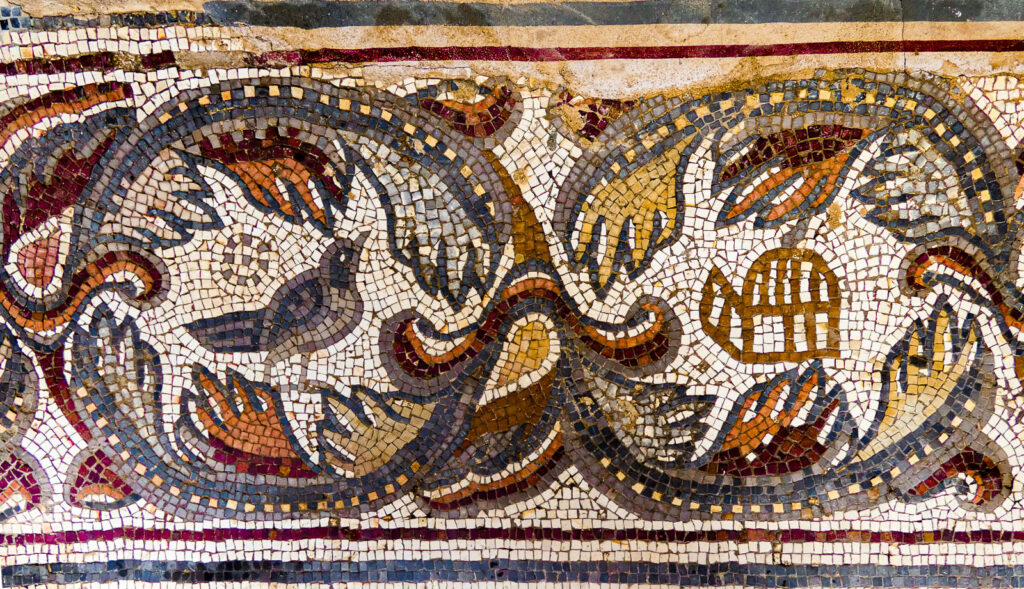
The Common Blackbird is a resident songbird of the thrush family. It appears in 6 mosaics, in the Golan, Upper Galilee, the Sharon, Jerusalem and the northern Negev, all in Christian buildings.
The male is identified by its entirely black plumage and its orange-yellow bill, and the female is brown and paler. The Ibex Mosaic at Caesarea shows dark black males and paler females. Both sexes have a conspicuous white ring around the eye and black legs.
At Nahariya a female blackbird, with a pale, speckled belly, is shown facing an open, empty cage, as part of the scene of bird hunting with limed sticks. In this context she is one of the birds that were hunted.
The blackbird lives in woodland, gardens and orchards, and gathers worms, insects and fruit on the ground and among the branches.
Hooded Crow
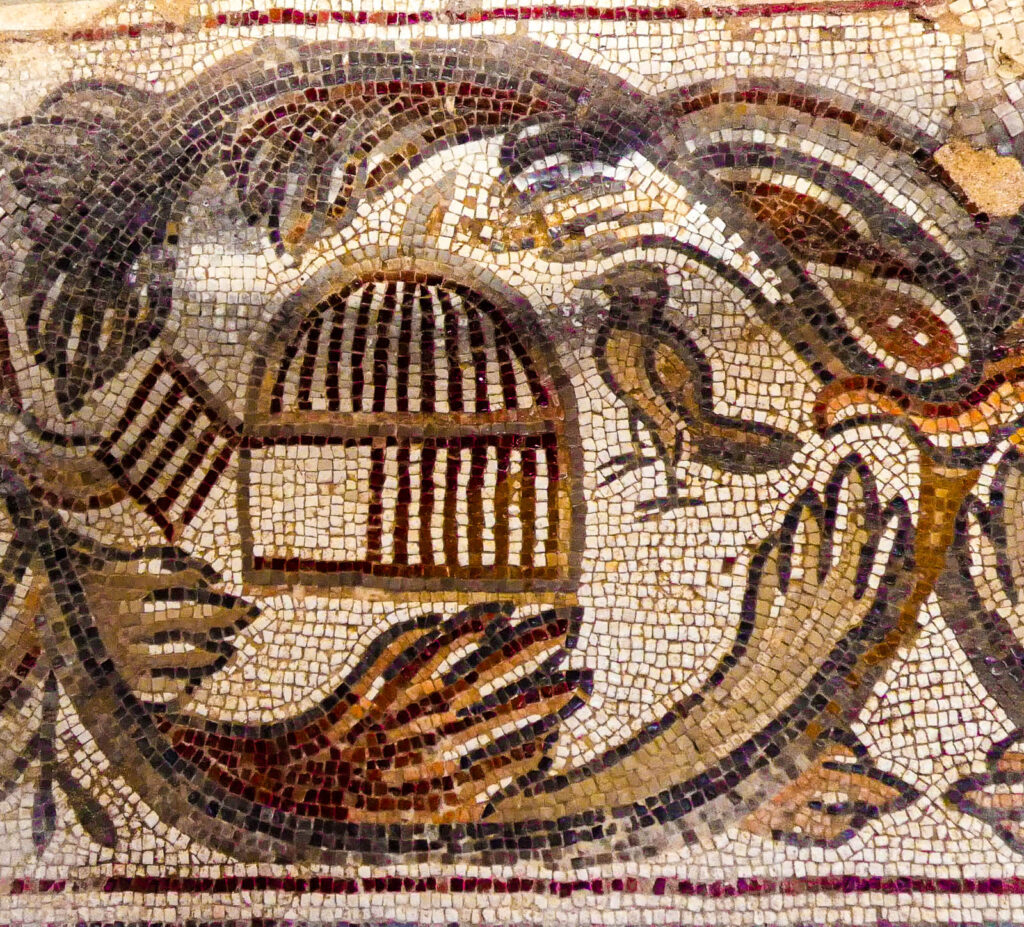
The Hooded Crow is a large songbird of the crow family, resident and common in the human environment. It appears in 3 mosaics, in Upper Galilee, Lower Galilee and Samaria, all in Christian buildings.
The Hooded Crow is identified by its grey body, its black head, wings and tail, its strong, black, relatively large bill, and its characteristic stance. It is a species with a character all its own, easy to identify even in a low-quality mosaic. At Nahariya it is depicted most accurately, compared with the other mosaics, which are of lower quality.
At Nahariya the crow is shown facing an open, empty cage, in the bird-hunting scene. The Hooded Crow feeds on almost anything, and in fields and orchards it damages the crop, so hunters and farmers had reasons to catch it.
Galliform Birds (Galliformes)
The birds of the order Galliformes included in this chapter are the Chukar Partridge, the Black Francolin and the Sand Partridge, as resident birds hunted for their meat and eggs. Other galliform birds depicted in the mosaics, the Domestic Chicken and the pheasant, are not included here, since they are domesticated and exotic species that are not part of the local fauna, and are discussed in the chapter on domestication; and the Common Quail is a migratory bird, not part of the group of resident birds, and is therefore discussed in the chapter on migratory birds.
The galliform birds demonstrate a spatial ecological distinction in the mosaic record: the Chukar Partridge has a wide range, including northern areas, the centre of the country and even the desert fringes; the Black Francolin appears in the Sharon and in Upper Galilee; and the Sand Partridge is confined to the western Negev. This pattern shows a correspondence between the depictions of the birds in the mosaics and their natural habitats, and attests to the familiarity of the patrons of the buildings and of the mosaic makers with the local fauna, to their distinction between Mediterranean and desert regions, and to the use of the local fauna for human needs. The appearance of the quail at a desert site fits its migration patterns, but its exclusion from the resident group sharpens the distinction between systematic and functional classification.
Chukar Partridge

The Chukar Partridge is a resident species with a wide distribution, not limited to a particular geographical area. It occurs in the north, the centre and the south of the country, including the desert fringes and the northern Negev, but is not characteristic of the most arid desert. In the mosaic record it is represented across the whole country and with especially high frequency, with 25 occurrences, ranking 2nd in frequency after the peafowl. Its distribution extends over the Golan, Upper and Lower Galilee, Mount Carmel, Samaria, the Jordan Valley, the Judaean Shephelah, Jerusalem, the Hebron Hills, the Judaean Desert and the northern and western Negev, with most occurrences in Lower Galilee and the Judaean Shephelah. 21 of the mosaics adorned Christian buildings, 3 Roman buildings and one a synagogue. This emphasises its central place in the local landscape, its connection with people and its importance as a species hunted for food and as a source of eggs.
When its relative frequency is examined against all the bird mosaic sites in each sector, it appears in about 43.8% of the Christian sites, compared with only about 12.5% of the Jewish sites. The symbolic meaning that the research literature attributes to the partridge rests on the Physiologus. According to it, a partridge that has no eggs of its own robs the nests of its companions, broods the eggs and raises the chicks, and when they grow up they return to their parents and abandon it (Bodenheimer 1957, p. 114). Ambrose repeats the story (Hexameron 6.3.13). The story is linked to Jeremiah 17:11, “As the partridge sitteth on eggs, and hatcheth them not”, where the Septuagint renders the Hebrew qore’ as πέρδιξ, partridge. In nature the partridge nests on the ground in a nest of its own, the female incubates her own eggs, and the chicks stay with their parents in a family covey until winter. The only realistic detail in the Physiologus chapter on the partridge is the use of the partridge as a decoy bird, whose call lures other partridges into the trap. A story with no basis in nature thus passes in research from one scholar to the next, unchecked against the source and unchecked against nature. The data from the Land of Israel show a different picture: the partridge appears in many mosaics, in pairs and families, in garden scenes, vine scrolls and medallions, in cages and in hunting set-ups. It is depicted as a bird people lived beside, hunted and raised for meat and eggs.
In Graeco-Roman literature the partridge is described mainly as a game bird and a food. Strabo mentions partridges among the luxury gifts brought to Augustus, and Pliny describes their rearing and their use for fighting. Aristotle describes hunting with a decoy partridge: when the decoy is a male, the wild male advances to attack it and is caught in the net (History of Animals 9.8, 614a). Aelian describes a tame partridge that calls to a wild male and lures it into a noose (On the Nature of Animals 4.16). Ben Sira, a source from the Land of Israel, compares the heart of the proud to a decoy partridge in a basket (11:30, in the Greek version). A calendar mosaic from Carthage, now lost, showed a decoy partridge in a cage beside the figure representing the month of July, probably as an allusion to the hunting season.
The Chukar Partridge was not domesticated, but it is kept in captivity and breeds well there, and the business of catching and raising it continues to this day. In Spain, for example, there are today hundreds of farms raising the Red-legged Partridge (Alectoris rufa), a congener of the Chukar Partridge, which raise more than three million partridges each year for release on hunting grounds. The breeding pairs are kept in cages, and most farms also sell males used as decoy partridges in traditional hunting (González-Redondo et al. 2010). The mosaics record the different stages. At Sepphoris – Agora (Double Axe), a partridge lies with its legs tied with a black cord: a live bird after capture. The depiction fits transport, sale or preparation in the kitchen for slaughter and cooking, as in the xenia scenes from North Africa and Italy. At Jerusalem – Armenian Funerary Chapel, a partridge is shown inside a wooden cage. At Aluma – Church, a partridge is shown inside a wicker cage; it is identified by its body build, its colouring and its relative size. At Sepphoris – Nile Festival Building, the partridges in the band of birds, beside the pheasants and the doves, are a group of birds kept in captivity. At Nahariya – Church, a pair of partridges in a single medallion in the south aisle, a male and a female. The pair attests to the breeding in captivity of partridges that had been caught. Such partridges were apparently also used as decoy birds, to maintain the breeding stock and to catch wild partridges alongside the coop. A close parallel outside the Land of Israel is found in the Petra church: a pair of partridges and a partridge in an open wooden cage.
In the Chukar Partridge there is almost no visual difference between the sexes. The male is slightly larger and has a spur on its legs. In mosaics where the depiction is precise, the spur allows the sex to be determined. At Nahariya the right-hand partridge is a male with a spur on both legs, and the other is a female without a spur. At Sepphoris – Nile Festival Building the right-hand bird is a male with a spur and the left-hand one a female. At Be’er Shema spurs are shown. At Halat el-Fula there is no spur, and the male is identified by its larger body and larger head.
In the Jewish buildings the partridge hardly appears. It is depicted only at Beth Alpha: 1 of 8 Jewish mosaic sites with birds, compared with 21 of 48 Christian mosaic sites. The Jewish buildings show other birds known to have been hunted or kept for food: the Domestic Chicken, the Common Pheasant, the Common Quail, the Pin-tailed Sandgrouse, the Sand Partridge and doves. It is possible that the partridge was not among the birds that the Jewish communities of the Land of Israel hunted, raised and ate in this period. It is also possible that they ate it but did not depict it. This is only a hypothesis, for two reasons. The number of Jewish sites is small. And in the Babylonian Talmud (Yoma 75b) the shikhli is listed as the choicest of the four kinds of quail, and Felix identifies it, apparently, with the partridge. A tradition of eating partridges is recorded in Jewish communities in the modern period, and it too says nothing about the custom of the Jews of the Land of Israel in the Late Roman and Byzantine periods.
Partridges are depicted in the mosaics as medium-sized, rounded birds, with colouring that matches their colouring in reality. The wide distribution of the partridge in the mosaics of the Land of Israel, together with the descriptions of its rearing and uses reflected in the literature of the period, shows that it was a familiar bird, hunted and valued for culinary and economic reasons. The mosaic floors thus served as a visual medium reflecting the culture, the economy, the everyday life and the world view of the owners of the buildings and of the society in which they lived.
Black Francolin

The Black Francolin appears in 2 mosaics: in the Birds Mosaic palace at Caesarea in the Sharon and in the Nahariya church in Upper Galilee, both Christian buildings. The francolin is a large ground bird, resident and hunted for its meat and eggs. Its distribution is characteristic of the north of the country and of the wetter regions; it was more common in the past, but never reached the wide countrywide frequency of the partridge. The two distinctive occurrences of the francolin continue the line that emerges from the research, according to which the depictions in the mosaics reflect the local fauna and flora. They attest to local realia: the francolin was rendered in a local design, with the intention of displaying the economic capabilities of the owners of the buildings and their pride. At Caesarea it belongs to an ensemble of hunted birds, and perhaps also birds kept in captivity, alongside ostriches, pelicans, Egyptian Geese and others, on a large-scale farm.
Sand Partridge

The Sand Partridge is a resident species characteristic of true desert regions. In the mosaic record it appears in 2 mosaics from the western Negev: in the synagogue at Ma’on-Nirim and in the Shellal church. This distribution reflects a clear link with hot, dry habitats. Although the southern part of the Ma’on-Nirim mosaic has not survived, it seems, from the arrangement of the birds in the preserved parts, that two males were depicted facing the females. This display probably attests to capture and even to attempts at breeding in captivity for meat and eggs, and reflects mastery over the surrounding nature. The focused appearance of the Sand Partridge also sharpens the research understanding of the regional correspondence and suitability of the depictions in the mosaics, which reflects familiarity with the local fauna of the desert regions, as well as the wish to display local achievements and abundance.
Summary – Resident Birds in the Mosaics and Their Relationship with People
The chapter presents an ecological and functional framework for analysing birds in the mosaics of the Land of Israel, based on the category of resident birds – species that accompany the human environment permanently in settled and agricultural space. Within this framework, species from different orders – Columbiformes, songbirds and Galliformes, together with the hoopoe, the African Swamphen and the Common Ostrich – were examined together on the basis of their frequency, their relationship with people and their role in the landscape.
In the mosaic record the Chukar Partridge and the Rock Dove stand out in particular, appearing with high frequency and across the whole country, and other species appear less often. Their frequency matches the ecological reality of the human environment. The many occurrences of the partridge and its wide distribution show its central place in the landscape. Partridges and Columbiformes were kept in captivity and used for meat, eggs and droppings. The songbirds appear in gardens and vineyards, and also as species hunted for food.
Alongside these species, further resident birds in the record should also be mentioned, among them the House Sparrow, the Laughing Dove, the Hooded Crow and other songbirds, which accompany the human environment and are an integral part of the settled space. These species are not always prominent in the mosaics, but their very appearance strengthens the picture of a living, familiar, everyday landscape, usually close to human dwellings.
The hoopoe and the African Swamphen add a further layer to our understanding of the category. The hoopoe, a ground bird striking in its colours and build, occurs around settlements and farmland and feeds on insects found in cultivated soil and open areas. Its appearance in the mosaics reflects familiarity with a bird common in the human landscape, with a distinctive appearance that makes it easy to identify. The African Swamphen, by contrast, is associated with wet habitats – marshes, pools and shallow bodies of water – but it too appears as a resident element of the landscape, mainly in areas rich in water. Its relatively large size and its conspicuous presence among the water plants made it a noticeable figure in the landscape, and it fits well into the ensemble of birds depicted in the mosaics, which combines both dry-land and wet environments.
The Common Ostrich, the largest of birds, was a resident species in the region, and its meat, feathers and eggs were used for human needs.
In terms of composition, the resident birds are set into the mosaics as elements of the landscape around the site: they appear as single birds, in pairs or as a family, in depictions of gardens, vineyards and farmland. This combination creates a continuous visual fabric in which the animal world is absorbed into the depiction of everyday life.
The findings show that the mosaic makers worked from direct familiarity with the surroundings of the mosaic sites, and that the patrons of the buildings chose to represent resident species that were common and relevant to the life of the local community. The correspondence between the frequency of the species in the record and their natural distribution and habitats strengthens the research understanding that this is a realistic representation of the birds, rooted in the ecological reality of the Land of Israel in the Late Roman and Byzantine periods.
Main Sources
Ancient sources
- Aelian, On the Nature of Animals 4.16.
- Aristotle, History of Animals 9.8, 614a.
- Babylonian Talmud, Yoma 75b.
- Ben Sira 11:30 (Greek version).
- Columella, On Agriculture.
- Martial, Epigrams.
- Oppian, Cynegetica (On Hunting).
- Physiologus.
- Pliny the Elder, Natural History.
- Strabo, Geography.
- Varro, On Agriculture.
Modern research
- Avital, A. 2022. Illustrations of Birds in Mosaics from the Byzantine Period in Judea, Samaria and the Sharon. Judea and Samaria Research Studies 31(2): 183–219 (Hebrew; revised English edition, 2026). https://doi.org/10.26351/JSRS/31-2/2
- Avital, A. 2024. Exceptional Mammals and Birds from the Roman Mansion Mosaic in Lod. Lod “Diospolis – City of God” 10: 99–122 (Hebrew; revised English edition, 2026).
- Avital, A. 2026. The Fowler, the Sparrowhawk and the Birds: Ancient Methods for Controlling and Exploiting Pest Birds in the Byzantine Church Mosaic at Nahariya. Preprint, Zenodo. https://doi.org/10.5281/zenodo.24040177
- Feliks, J. Partridge. Encyclopaedia Judaica, s.v.
- González-Redondo, P., Delgado-Pertíñez, M., Toribio, S., Ruiz, F. A., Mena, Y., Caravaca, F. P. and Castel, J. M. 2010. Characterisation and typification of the red-legged partridge (Alectoris rufa) game farms in Spain. Spanish Journal of Agricultural Research 8: 624–633.
- Paz, U. 1993 [1986]. Birds. Plants and Animals of the Land of Israel: An Illustrated Encyclopedia, vol. 6 (ed. A. Alon). Tel Aviv: Ministry of Defence – Publishing House and Society for the Protection of Nature in Israel (Hebrew).