Introduction
The Nile mosaic of Palestrina (ancient Praeneste, about 35 km east of Rome) is the most detailed landscape of Egypt to have come down to us from the ancient world. It was made at the end of the 2nd century BCE and paved the apse of a large hall on the north side of the town’s forum. It was probably made by artisans from Italy, who documented Egypt after their journeys along the Nile. Today it is displayed in the National Archaeological Museum of Palestrina, in the Palazzo Colonna-Barberini.
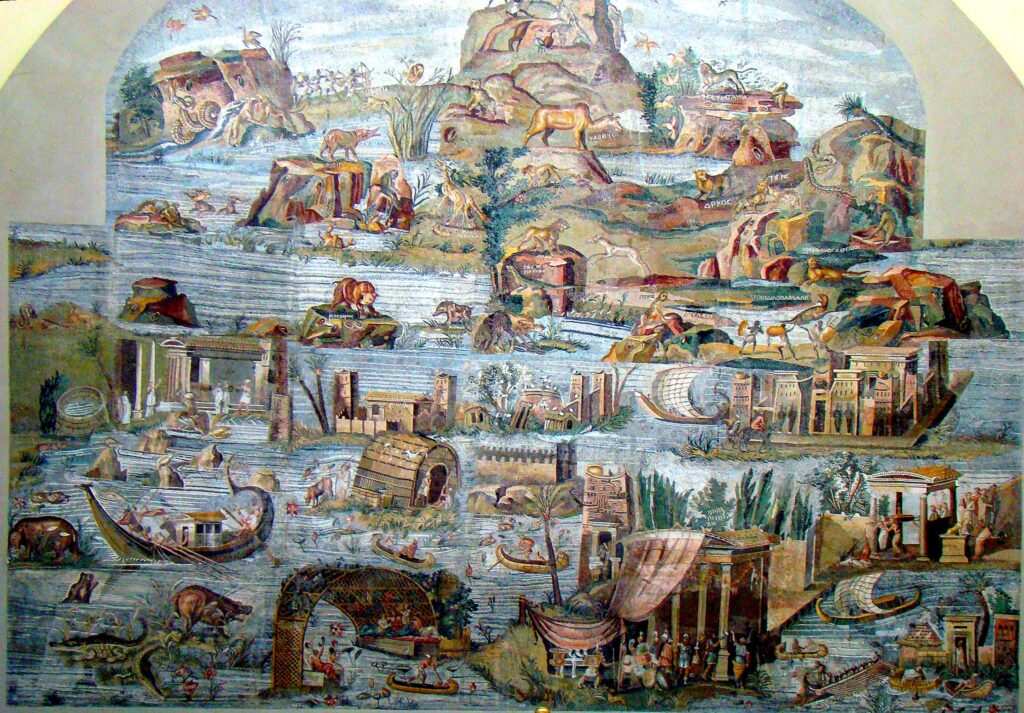
The photographs on this page were taken in the museum by the author (2011). Their original colours have been enhanced to show the mosaic as it probably looked to visitors at the site, when it was wet from the water that flowed over it.
The mosaic presents a general view of the land of the Nile from north to south: from the entrance at the harbour of Alexandria, southward along the Nile as far as Ethiopia. The upper part, displayed today upright on the wall, was the farthest from the eyes of a visitor entering the mosaic area when it lay on the floor. The far south is reduced in scale, creating a clear perspective of near and far. This is a general landscape view, without a route, and in this it differs from the route map in the Nile Festival Building at Sepphoris, which depicts what is seen along a route. The viewpoint is probably the Serapeum hill in the south-west of Alexandria, from which the city stays behind the viewer. The mosaic shows fortresses and scattered farmland, with no city as such, no gates and no walls. Leonardo Salari suggested the top of the lighthouse, which stood on the island of Pharos at the harbour entrance, but from there the city itself would be in view.
The scenes are set within a view of the canals and channels of the Nile Delta at the time of the flood. The view is general, from north to south, and the scenes are scattered freely, like the flooded fields themselves, with human and animal activity across them.
The mosaic is divided into two nearly equal strips, like the Nile Festival mosaic at Sepphoris. The lower strip is inhabited and built-up Egypt: temples, fortresses, farmhouses and dovecotes, soldiers and ceremonies, farming, hunting and boating on the flood waters of the Nile. The upper strip is the wildlife of the Upper Nile: mountains and rocks, the large mammals of the African savannas, and hunters from Ethiopia.
As early as 1911 the historian Michael Rostovtzeff read the buildings of the mosaic as a record of the real Egypt. An English translation of the passages he wrote on Palestrina is given on a separate page.
The artisans and the depiction
It seems that the artisans who created it set out from Italy on a long journey along the Nile. Gathering information of this kind took several years, and there may have been several expeditions, each to a different part of the Nile. During the journey they probably came to know the culture, recorded and drew the buildings, ceremonies, plants and animals, and prepared sketches in colours true to life. They apparently identified and defined the animals and collected their names while still in Egypt, and on their return laid the floor in place at Praeneste.
All the depictions show local realia: in motion, lively, flowing and colourful, at a level of description almost unknown in mosaic art, and certainly not over so large an area. The mosaic is about 5.85 m wide and 4.31 m deep, and is made of more than half a million stones. Many of them are tiny, only a few millimetres in size, and were probably set with tweezers. Direct observation is evident in every depiction: the rocks, the water channels, the birds, the plants and the mammals, and the people in their various roles and activities. Together they reveal the enormous variety of human activity, animals, plants and landscape in the wondrous land of Egypt.
The lower strip: inhabited Egypt
The farmhouse and the dovecote
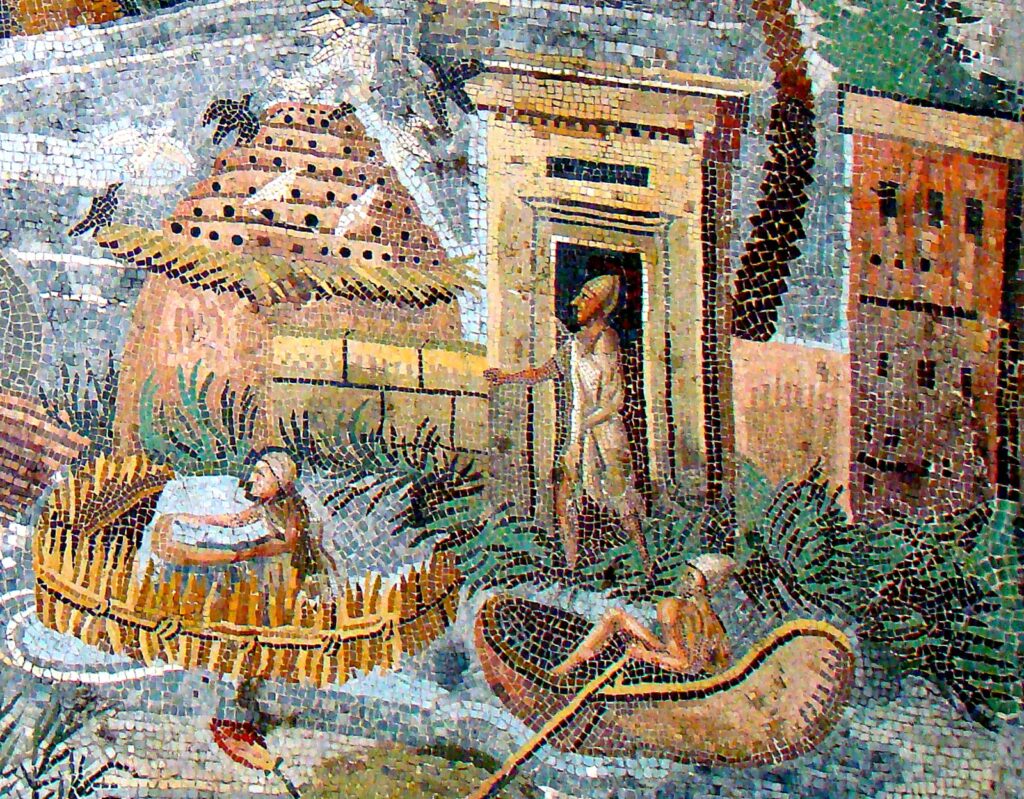
At the farmhouse the farmer stands in the doorway, watching a bird entering the dovecote. The dovecote is made of straw, on the roof of a small storehouse at the side of the yard. One bird is in flight, and another stands at the edge of the eaves. These appear to be three generations: the farmer; his old mother in front, rolling out dough inside a reed fence; and his son, or another young man, sitting in a boat and looking at the bird.
The tower on the right, behind, is perhaps a residential tower, or a residential tower combined with a dovecote. Residential towers of this kind were apparently built for security and to keep clear of the floods.
The residential tower
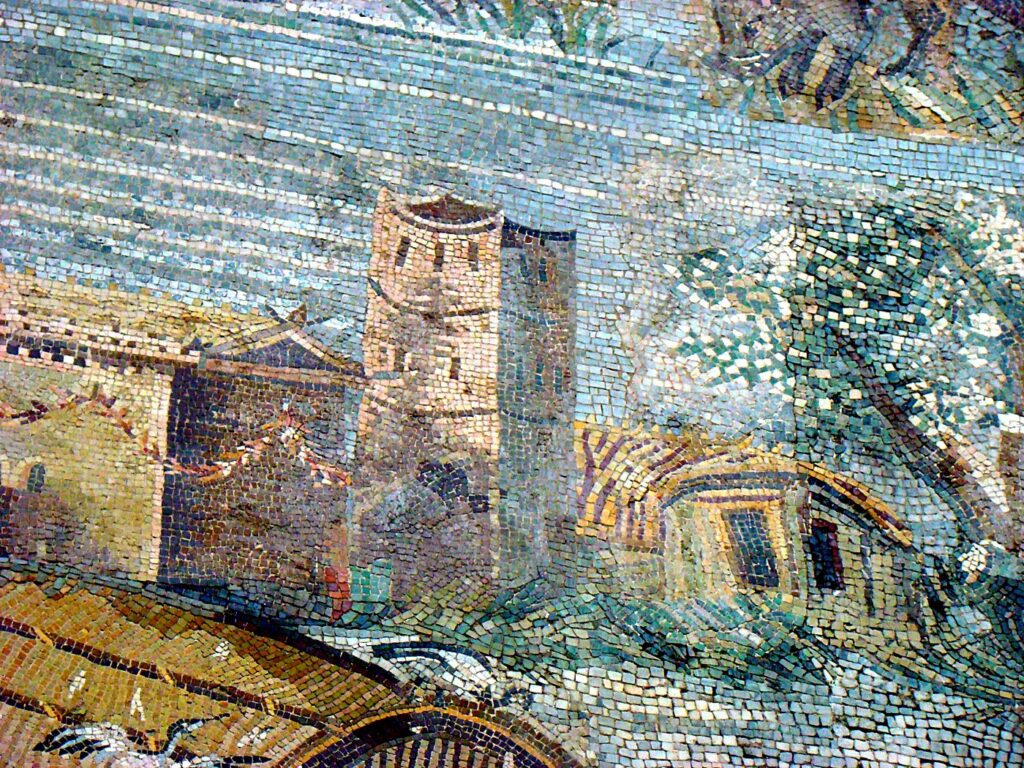
Another residential tower, topped by a flat concave roof.
Leaning palms
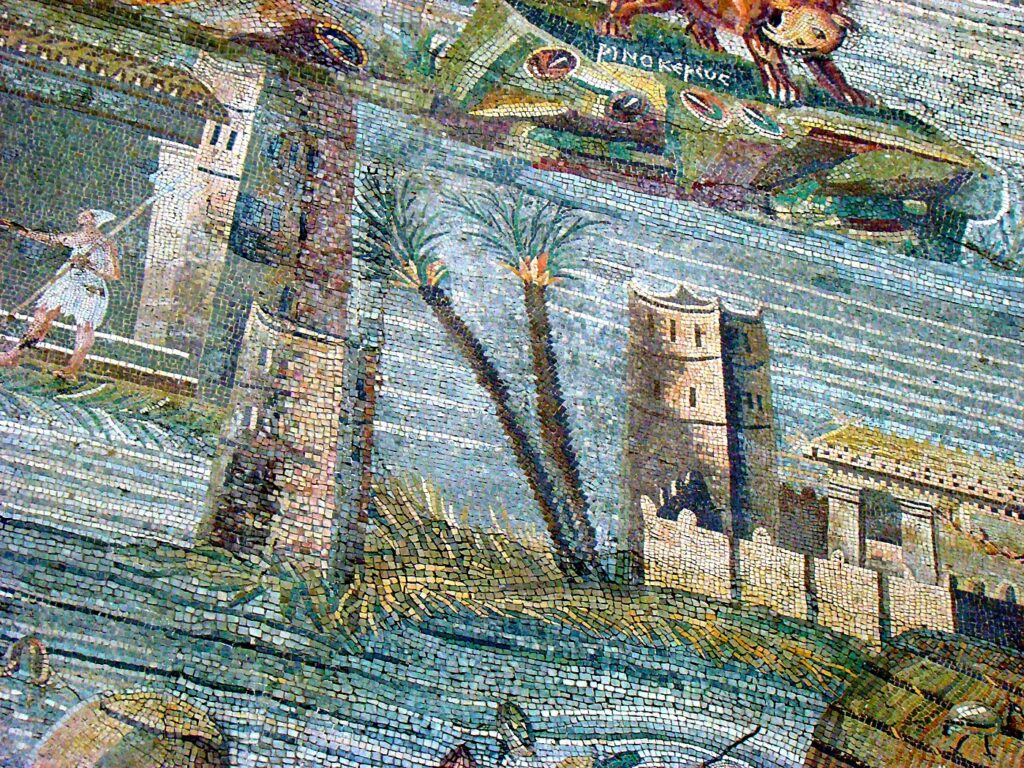
By the entrances of various buildings stand palm trunks leaning to the side. These are probably palms whose roots are submerged in water, losing their hold in the flooded mud.
The temple and the priests in white
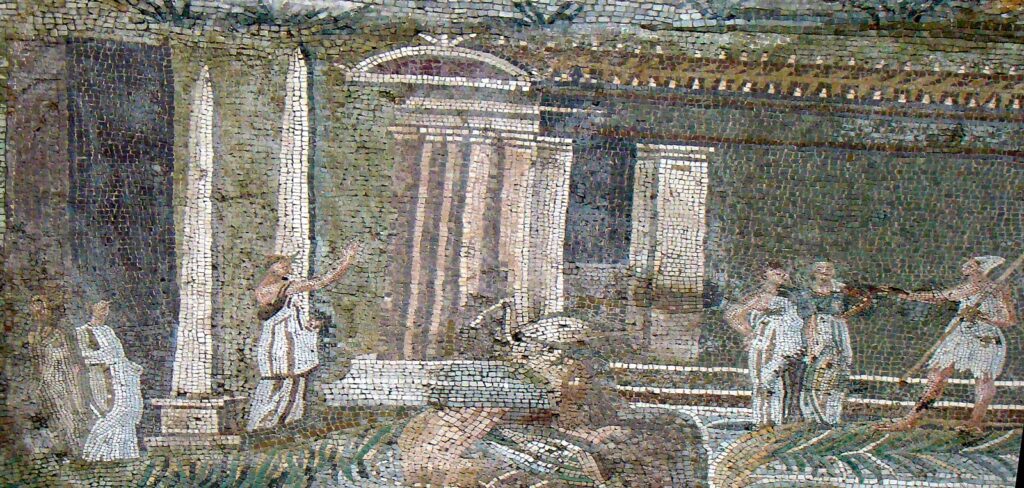
In front of a temple in Hellenistic style stand priests dressed in white, one of them raising his hand. Beside it is a building with a large round water well.
The procession and the jackal statue
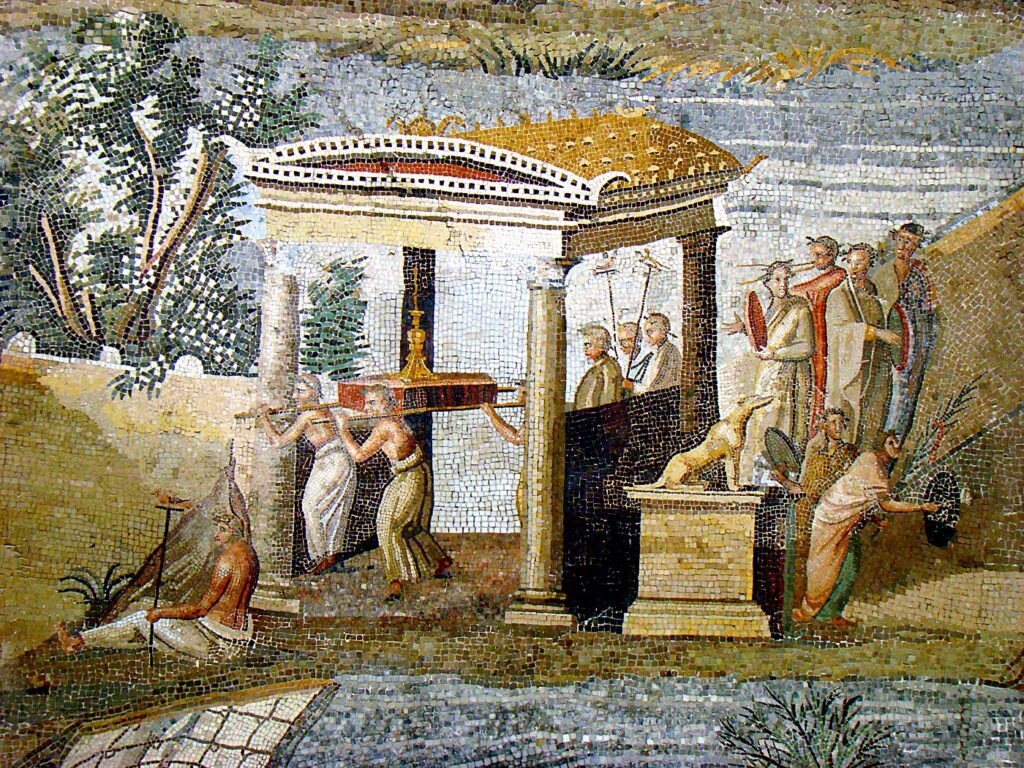
A procession descends towards the Nile. Four men carry the coffin, on which stands a gilded portable altar. Immediately behind the coffin walk three priests with shaven heads. Two of them hold staffs topped by a bird and a lizard, probably an agama. Behind them walk six mourning women with double pipes and drums. The procession passes through an open colonnaded building, in front of which, on a high base, stands a statue of a jackal, the emblem of the god Anubis. At the top of the steps leading down to the water sits a priest holding a staff with a bird on it, probably a live one. Paul Meyboom interprets the scene as the funeral procession of Osiris (Meyboom 1995: 144).
The soldiers
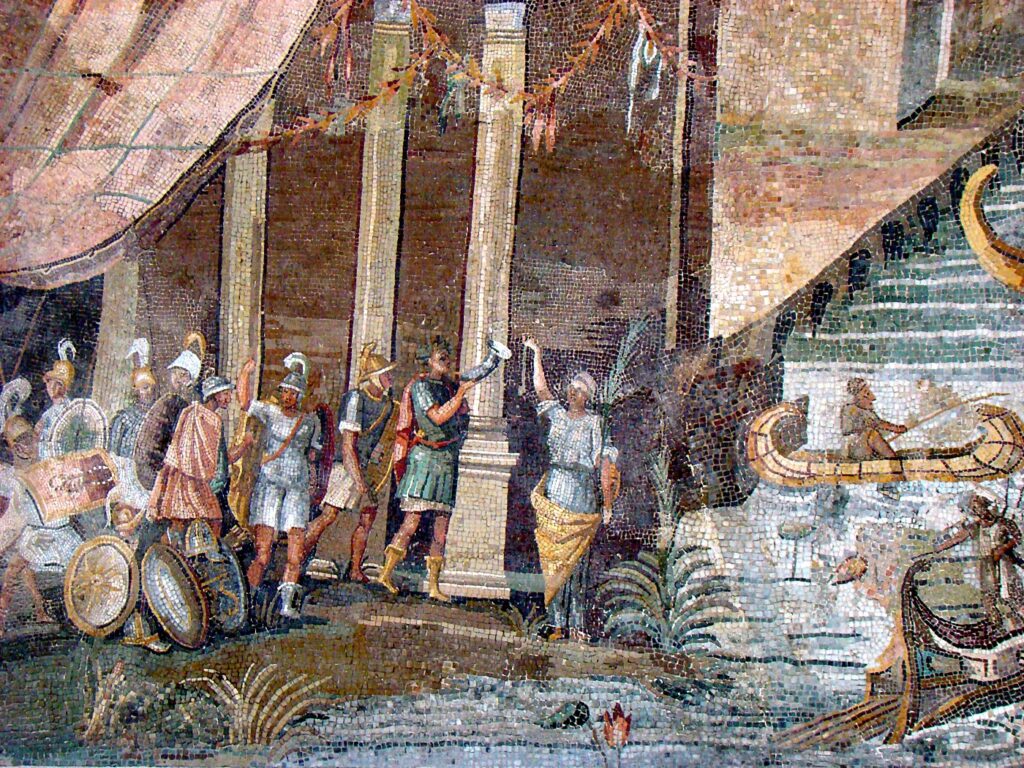
In a large pavilion, with garlands hanging between its columns and a large awning covering it, stand about ten soldiers in Hellenistic equipment. These are soldiers returning victorious from battle. They are received by a female figure wrapped in a gilded mantle and holding a palm branch, and the first soldier salutes her by sounding a curved horn with a wide metal mouth. More horns lie on a table, and the preparations for the victory celebration are visible.
The round shields are set aside, bearing an emblem of a circle with rays, like a sun. The sun emblem is known as the emblem of the Macedonian royal house. On the backs of two soldiers are rectangular plaques with a scorpion emblem. Most scholars identify the soldiers as Ptolemaic soldiers, and Filippo Coarelli read the scene as a Ptolemaic victory celebration.
The soldiers’ boat
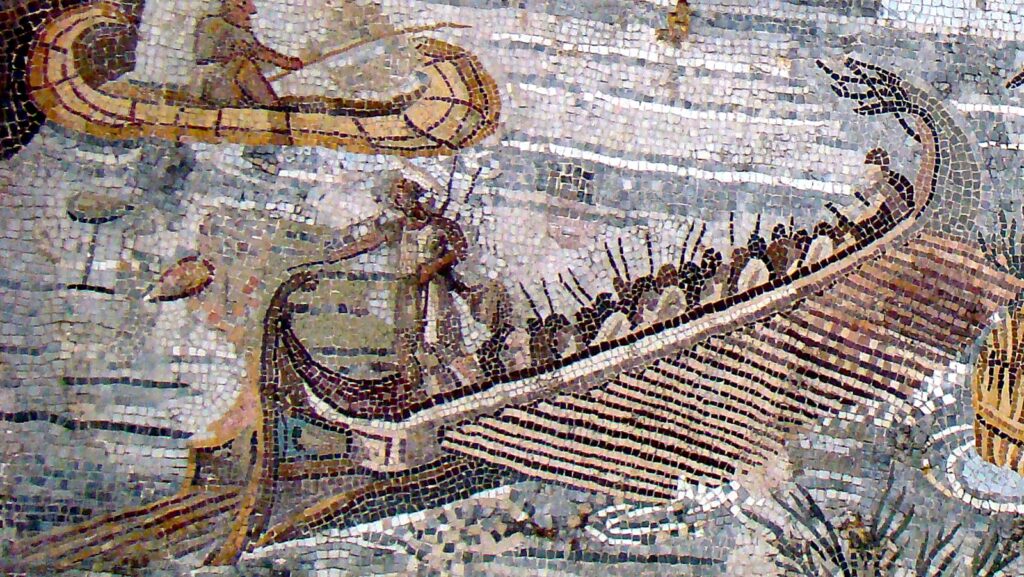
Opposite the farmhouse lies a long boat in which soldiers sit with shields and weapons. The oars are at rest, and the commander stands at the end of the boat, directing his men to go ashore over a gangway of reeds. The scene appears to be connected with the soldiers returning victorious from battle, who are received by the female figure.
The fortress with the eagle
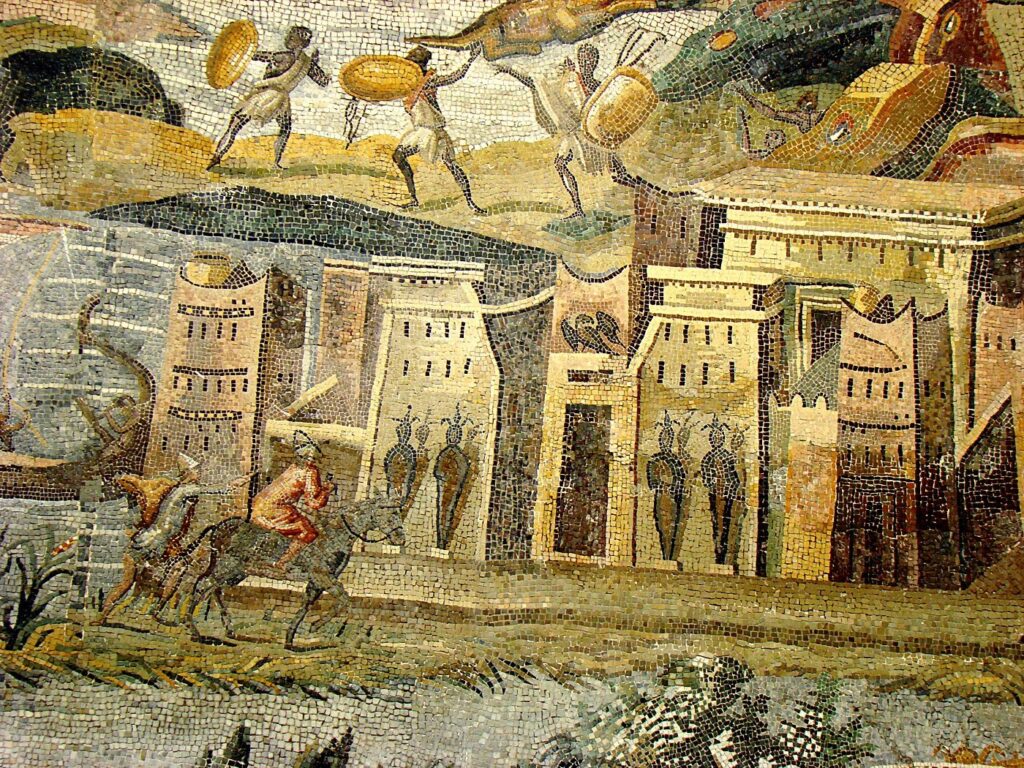
At the front of a large fortress four figures stand in pairs on either side of the entrance. These are Osiris-Canopus jars with a feathered crown, described in the literature as statues of Osiris. Above the entrance is an eagle with spread wings, the eagle of the house of Ptolemy. Approaching the entrance of the building are a rider on a horse and a man on foot with a sack on his left shoulder, pointing ahead.
The barrel-vaulted arbour
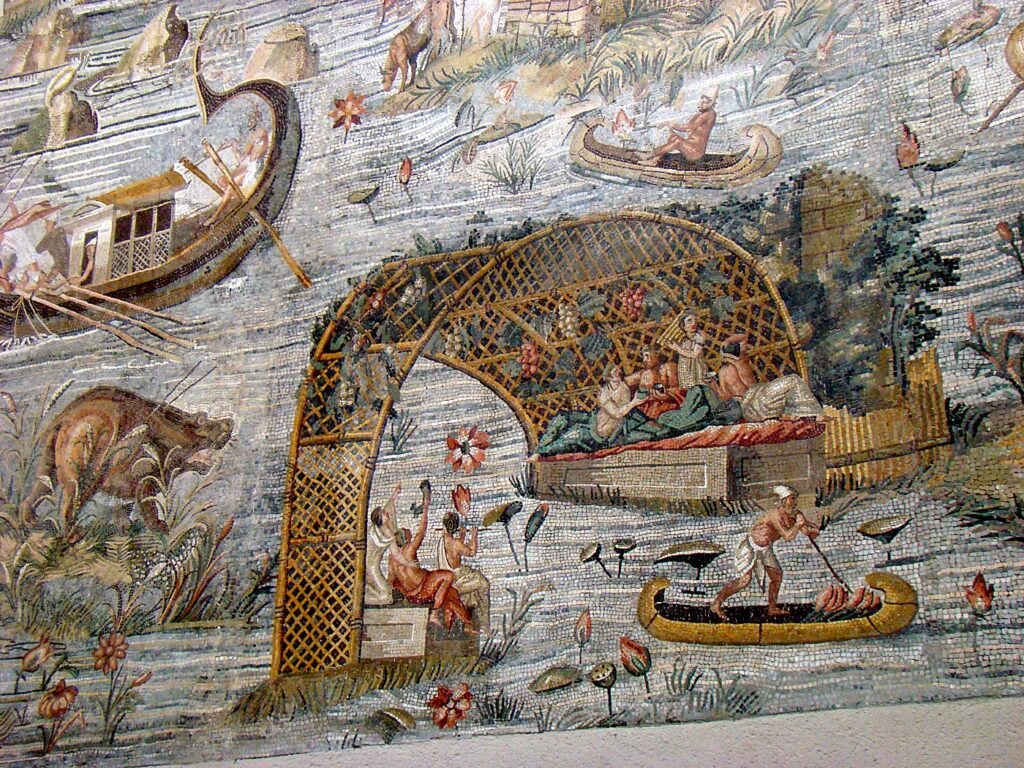
Above the flood waters of the Nile an arbour was built in the form of a barrel vault, overgrown with vines bearing round bunches of red and yellow grapes. Inside it banqueters recline: one plays a slanting panpipe, others sing, cheer and drink. Beneath the arbour a farmer in a white hat paddles a canoe loaded with red lotus buds he has picked in the Nile. The banquet apparently presents the good life of the wealthy of Egypt.
The hippopotamus hunt
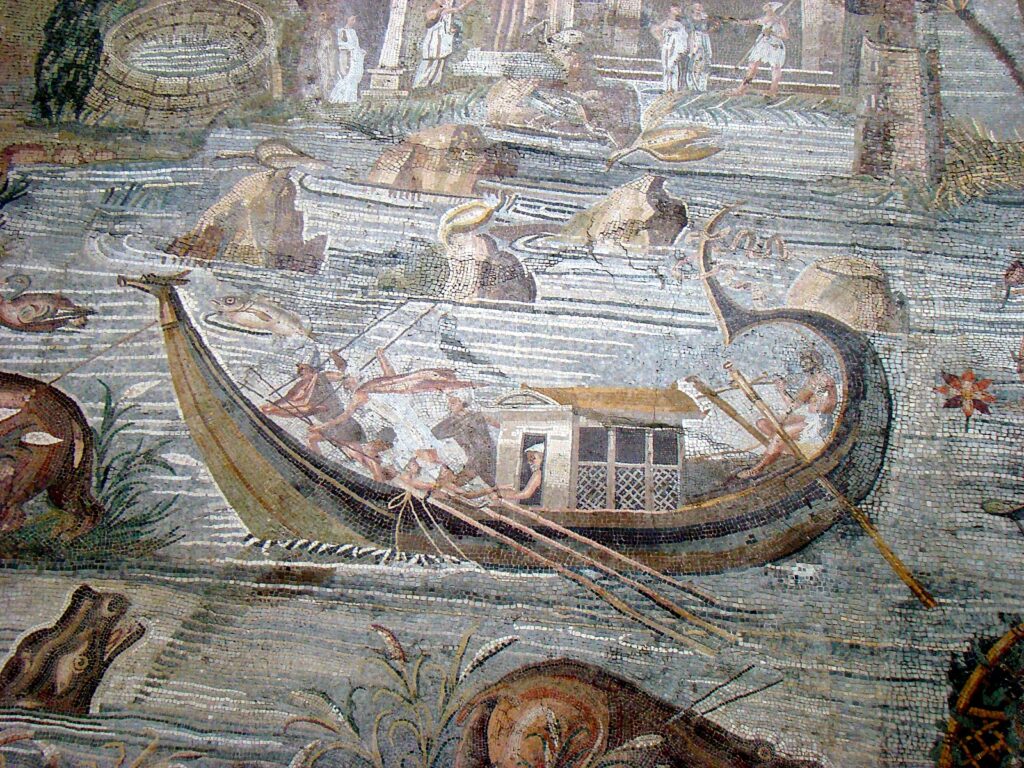
A hippopotamus hunt from a large boat. On its prow is a statue of a jackal, and in its centre a cabin for the crew. In the front part of the boat hunters hurl spears and harpoons at the hippopotamus, and the harpoon lines stretch towards it. At the stern sits the helmsman, holding the steering oars.
The reed building and the cow
Farther away stands another barrel-shaped reed building. At its entrance are two workers with a pitchfork, both in a resting posture. A cow goes down to drink from the Nile, watched over by a bearded worker in a white hat. On the roof are two large water birds, perhaps ibises.
The fortress of the ibises
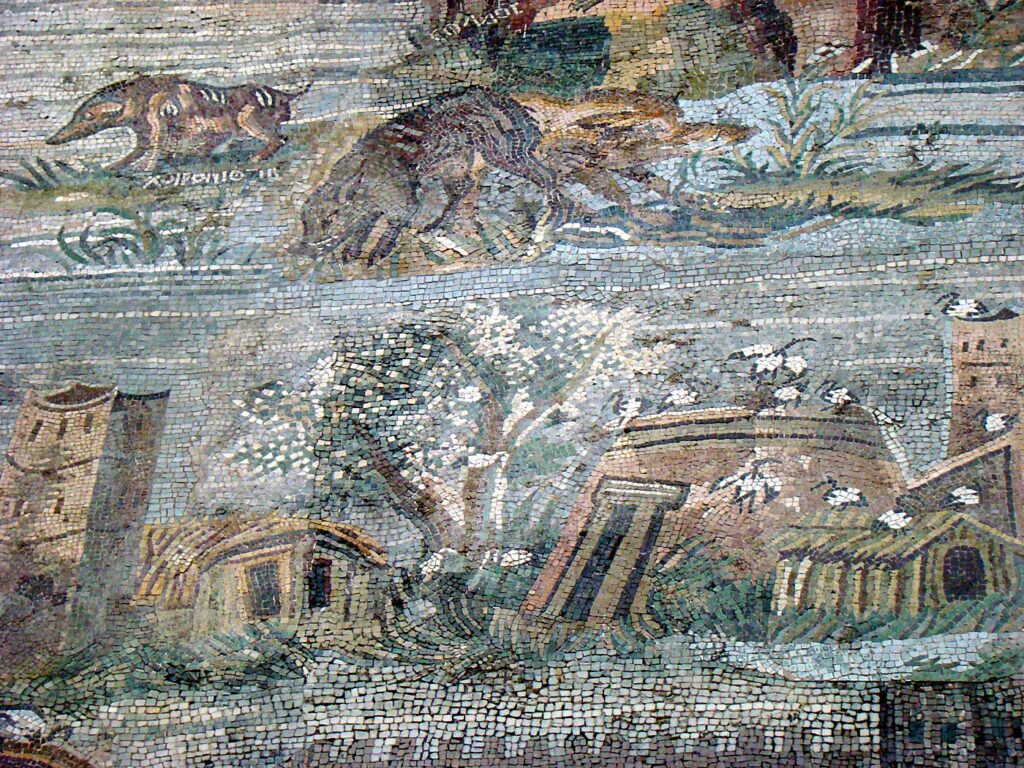
On the roofs of a distant brick fortress gather about ten sacred ibises, the bird of the god Thoth. The fortress is enclosed by a wall with two square watchtowers, topped by flat concave roofs. The main entrance tower is round and broad, and it is the only round tower in the mosaic. Rostovtzeff identified in the mosaic the “ibion”, the place where ibises were kept and fed, often mentioned in the papyri.
The style of the buildings is Ptolemaic-Egyptian and Hellenistic: the built structures have no arches, the doorways are in the Attic style, and the capitals are Doric.
The upper strip: wildlife of the Upper Nile
The upper strip shows mountains and brown-reddish rocks, probably the red-brown Nubian sandstone. Scattered across it are hippopotamuses and crocodiles, belonging to the water environment, and on dry land the large mammals of the African savannas and a large coiled snake. In the highest part are dark-skinned archers, people of Ethiopia, which for those who came from Europe was the edge of the known world along the Nile.
This strip recalls the octagon of the Lod mosaic, which shows lions on either side of mountains, with a body of water between them. In the water is a hippopotamus with a curled tail, which points to a link between the owners of the house and the god Neptune, probably as a substitute for the god Nilus. In the foreground of the scene are large savanna mammals. At Palestrina everything is larger, more detailed and of higher workmanship.
The large mammals are depicted in the distant part of the mosaic, with their names in Greek beside them. The labels are a rare source for understanding several things. They show that the artisans depicted realia, and that they brought to Italy a kind of encyclopedia for getting to know Egypt. They wished to give the names of the animals for visitors in Italy and to teach them. In Egypt they probably had local guides who taught them the animals and their names, and they knew how to write it all down and set it in the mosaic with correct spelling. This is an innovation that apparently had no precedent, and certainly not in mosaic.
A similar method of labels beside the animals is seen in the Sidonian burial cave at Tel Maresha (Marisa, near Beit Guvrin), for the benefit of local visitors.
| Label in the mosaic | Transliteration and meaning | Identifications proposed in research |
|---|---|---|
| ΚΡΟΚΟΔΙΛΟΣ ΧΕΡΣΑΙΟΣ | krokodilos chersaios – land crocodile | Desert monitor, Varanus griseus |
| ΚΡΟΚΟΔΙΛΟΠΑΡΔΑΛΙΣ | krokodilopardalis – crocodile-leopard | Nile monitor, Varanus niloticus |
| ΣΑΥ[Ρ]ΟΣ … | sauros – lizard; reading of the second line uncertain | Yellow-throated plated lizard, Gerrhosaurus flavigularis (?), or another monitor |
| ΣΦΙΝΓΙΑ | sphingia – ‘sphinx’ monkeys (plural or diminutive) | Green monkey, Chlorocebus/Cercopithecus |
| ΚΗΠΙΕΝ | kepien (kepos/kebos) – ‘garden monkey’ (?) | Yellow baboon, Papio cynocephalus, or hamadryas baboon, Papio hamadryas |
| ΗΟΝΟΚΕΝΤΑΥΡΑ | (h)onokentaura – donkey-centauress | Gelada, Theropithecus gelada (?) |
| ΚΡΟΚΟΤΤΑΣ | krokottas – the Ethiopian name for the hyena | Striped hyena, Hyaena hyaena |
| ΘΩΑΝΤΕΣ | thoantes (thoes) – ‘thoes’ | Spotted hyena, Crocuta crocuta (?) |
| ΛΥΓΞ | lynx – lynx | Serval, Leptailurus serval |
| ΛΕΑΙΝΑ | leaina – lioness | Lioness with a cub (shown with a mane) |
| ΤΙΓΡΙΣ | tigris – tiger; today ΤΙΓΥΙΣ, a restorers’ correction | Cheetahs, Acinonyx jubatus (‘Ethiopian leopards’) |
| ΕΝΥΔΡΙΣ | enydris – otter | Spotted-necked otter, Hydrictis maculicollis |
| ΑΡΚΟΣ | arkos (arktos?) – bear (?) | Syrian brown bear, Ursus arctos syriacus |
| ΡΙΝΟΚΕΡΩΣ | rhinokeros – rhinoceros | African rhinoceros |
| ΞΙΟΙΓ | xioig – a label added by the restorers; the figure is original | Warthog (?) according to Salari 2012; elephant according to Kinzelbach 2009 |
| ΧΟΙΡΟΠΙΘΗΚ[ΟΣ] | choiropithekos – pig-monkey | Red river hog, Potamochoerus porcus |
| ΚΑΜΗΛΟΠΑΡΔΑΛΙΣ | kamelopardalis – camel-leopard | Giraffes, Giraffa camelopardalis |
| ΝΑΒΟΥΣ | nabous – the Ethiopian name for the giraffe (Pliny) | Eland antelope (?) according to Salari 2012; baboon according to Whitehouse 1976 |
| ΣΑΤΤΥΟΣ | satyros – satyr; the label survives only in the Dal Pozzo drawings | Chimpanzee, Pan troglodytes |
The animals of the upper strip
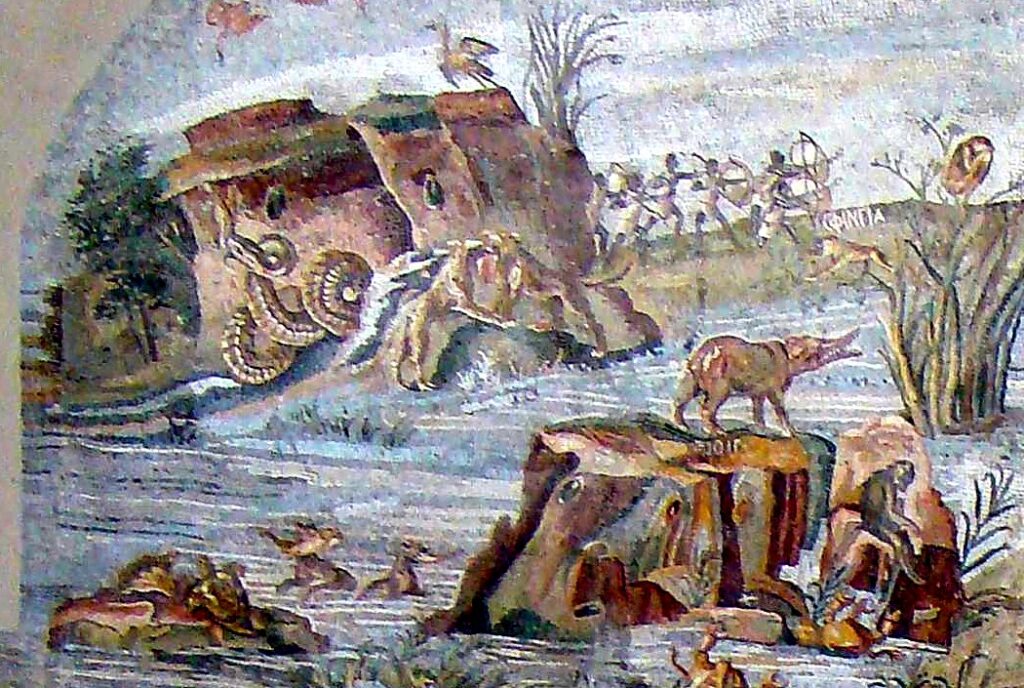
Dark-skinned archers, a large snake coiled around a rock, and on a rock an animal with a trunk, an elephant according to Kinzelbach. Beside the archers is the label ΣΦΙΝΓΙΑ.
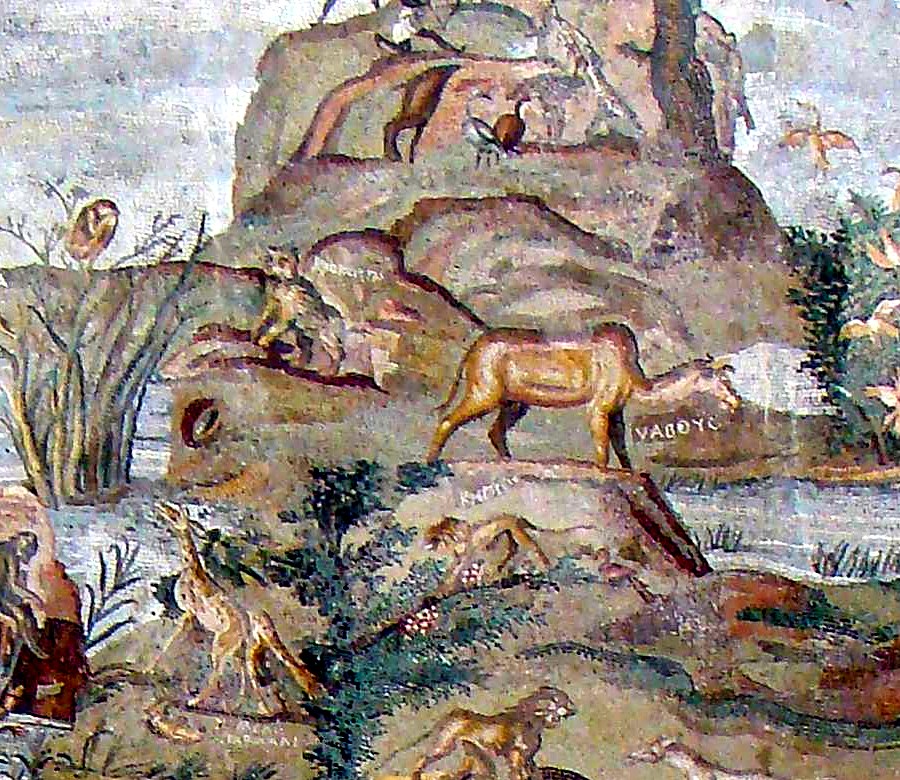
The tall animal labelled ΝΑΒΟΥΣ, surrounded by giraffes and monkeys on the mountain.
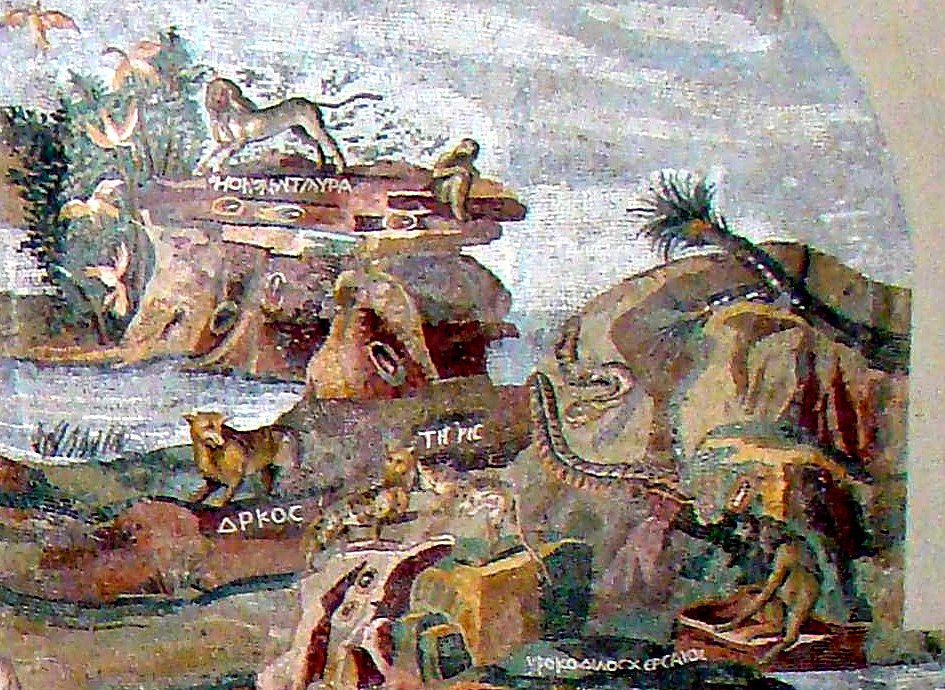
The labels ΗΟΝΟΚΕΝΤΑΥΡΑ, ΑΡΚΟΣ and ΤΙΓΡΙΣ, a snake on the rock, and at the bottom ΚΡΟΚΟΔΙΛΟΣ ΧΕΡΣΑΙΟΣ.
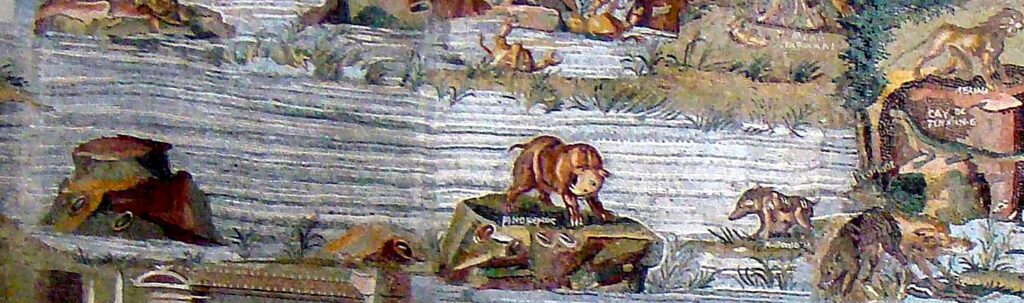
The rhinoceros labelled ΡΙΝΟΚΕΡΩΣ on a rock, and beside it smaller mammals.
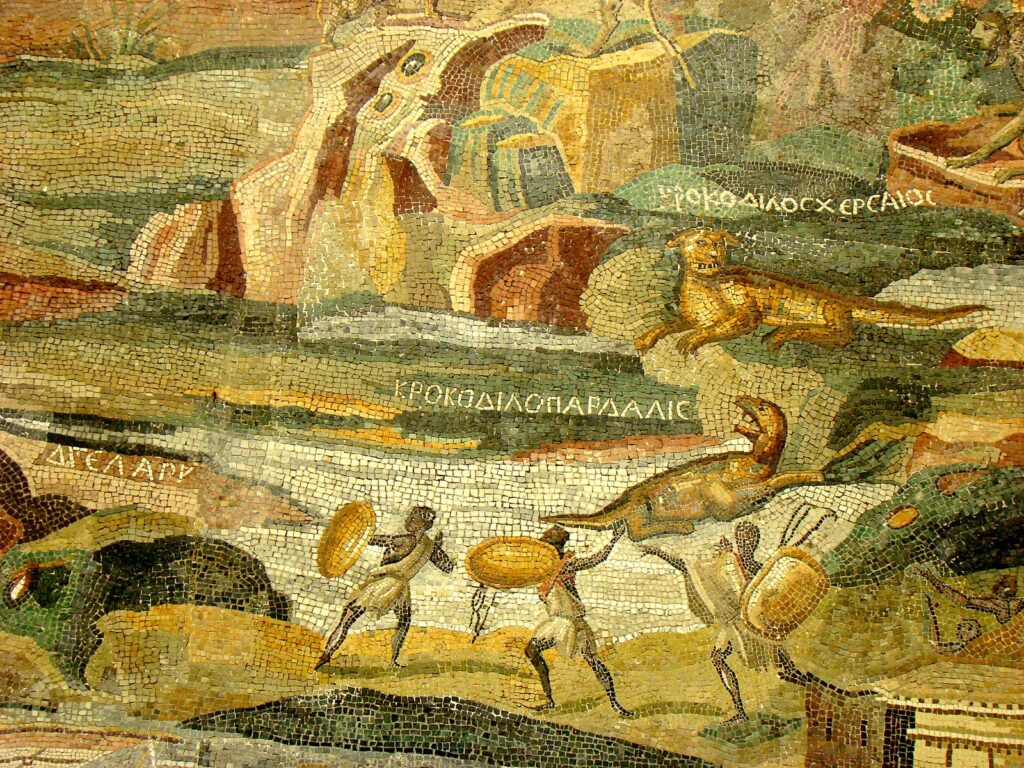
The two monitors labelled ΚΡΟΚΟΔΙΛΟΣ ΧΕΡΣΑΙΟΣ and ΚΡΟΚΟΔΙΛΟΠΑΡΔΑΛΙΣ, and dark-skinned hunters with shields attacking one of them.
Birds in Nilotic mosaics in the book: Birds in a Nilotic context.
Rostovtzeff 1911: real Egyptian buildings
In his article on Hellenistic-Roman architectural landscapes (1911), Rostovtzeff explicitly asked whether the pictures correspond to reality. He checked the buildings of the Nilotic landscape against papyri, excavations and clay models, and found that they are real Egyptian buildings. The farmhouse in the Palestrina mosaic, with its wall, gate, tower, garden and dovecote, is the country house of Ptolemaic and Roman Egypt. The pavilion in which the soldiers celebrate is paralleled, in his view, by a banqueting pavilion excavated on an island in Lake Mareotis, near Alexandria. The buildings he identified as real Egyptian buildings agree with the documentation made in the field.
Rostovtzeff was among the first to stand in wonder before the possibility that the pictures depict reality. He identified the style of the buildings as Ptolemaic-Egyptian and Hellenistic, and showed that the paintings were “imports”: they were made from observation in Egypt itself, and they are realistic and depict reality. Today it is clear that the mosaics depict local realia. In mosaics from the Land of Israel that include sections from Egypt, inscriptions such as Alexandria or Egypt were usually placed so that the viewer would understand that the landscape before him is an Egyptian landscape. At Palestrina too, the labels convey information from an exotic, distant land to the Italian viewer, who had never seen such landscapes and animals.
The reading on this page expands Rostovtzeff’s reading, on the basis of close-up photographs of the mosaic, which is well preserved on the museum wall. The full English translation of the passages Rostovtzeff wrote on the Palestrina mosaic.
Location, date and history
The mosaic covered the floor of the apse at the end of a large rectangular hall that opened onto the north side of the forum of Praeneste. Water flowed over the mosaic, and the apse functioned as a nymphaeum, an artificial grotto. Paul Meyboom dates the mosaic to about 120–110 BCE.
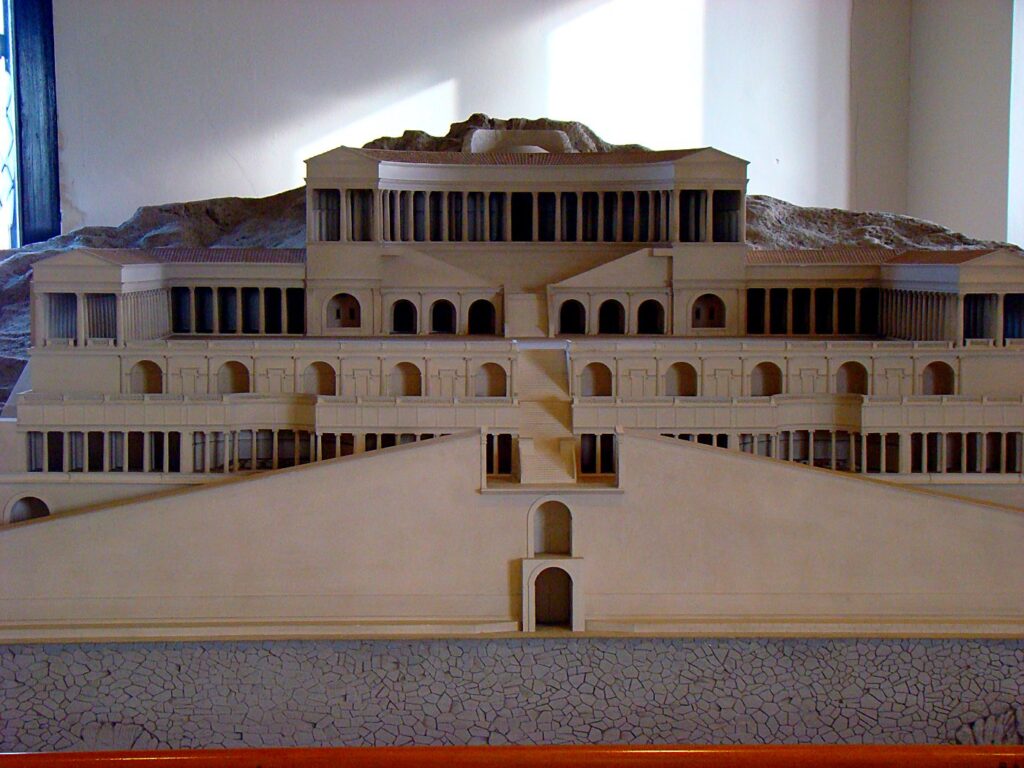
The museum is housed today at the top of the great Sanctuary of Fortuna Primigenia, built in terraces on the hillside. In the past the mosaic was identified with the stone pavement that Sulla laid in the sanctuary of Fortuna, according to Pliny. Research of recent decades has shown that the mosaic is earlier, and that its original place was in the forum hall in the lower part of the town.
The mosaic was already known in the 16th century. In 1614 it was visited by Federico Cesi, founder of the Accademia dei Lincei, and around 1630 the painter Vincenzo Manenti drew it for Cassiano dal Pozzo. The watercolours are kept today in the Royal Library at Windsor. In 1624–1626 the mosaic was lifted, cut into pieces and taken to Rome. In 1640 it was restored by Giovanni Battista Calandra for the Barberini family, and reassembled in an order different from the original. After the Second World War it underwent a further restoration.
The Dal Pozzo drawings, published by Helen Whitehouse in 1976, show the mosaic as it was before Calandra’s restoration. Thanks to them one can identify figures altered by the restorers, labels that were corrected and even animals that have disappeared from the mosaic, and on their basis Meyboom reconstructed the original arrangement.
Further reading
- Rostowzew, M. 1911. “Die hellenistisch-römische Architekturlandschaft.” Mitteilungen des Deutschen Archäologischen Instituts, Römische Abteilung 26: 1–186. Scan at the Internet Archive
- Meyboom, P. G. P. 1995. The Nile Mosaic of Palestrina: Early Evidence of Egyptian Religion in Italy. Leiden: Brill (2nd ed. 2016).
- Whitehouse, H. 1976. The Dal Pozzo Copies of the Palestrina Mosaic. BAR Supplementary Series 12. Oxford.
- Coarelli, F. 1990. “La pompé di Tolomeo Filadelfo e il mosaico nilotico di Palestrina.” Ktema 15: 225–251.
- Salari, L. 2006. Mosaico nilotico di Palestrina: animali reali o fantastici? Archeozoologia di una produzione artistica d’età ellenistica. Palestrina.
- Salari, L. 2012. “Mosaico nilotico di Palestrina: nuovi dati sulle raffigurazioni zoomorfe.” In Lazio e Sabina 8, edited by G. Ghini and Z. Mari, 349–357. Roma: Quasar.
- Kinzelbach, R. 2009. Tierbilder aus dem ersten Jahrhundert: ein zoologischer Kommentar zum Artemidor-Papyrus. Berlin.
- Tammisto, A. 1997. Birds in Mosaics. Acta Instituti Romani Finlandiae 18. Roma.
- Avital, Anat. 2026. Three Gateways to Egypt: The Nile Festival Mosaic at Sepphoris as a Geographical and Hodological Route Map. Zenodo. doi:10.5281/zenodo.23453633