Birds depicted in the mosaics in a Nilotic context, from the Late Roman and Byzantine periods in the Land of Israel, appear in a variety of species, most of them true waterbirds. Some of them also belong to the fauna of the Land of Israel, but in the mosaics of the Land of Israel they are depicted only in a Nilotic context. Assignment to this chapter is determined by the context of the illustration in the mosaic: it includes the species that, in the mosaics of the Land of Israel, are depicted only within Nilotic scenes. The group is heterogeneous in zoological and ecological terms, and the uniform scenographic framework makes it possible to discuss it as a single group.
The features of the Nilotic scene and the connections with Egypt are presented on the page Connections with Egypt and the Land of the Nile.
The group of birds depicted only in a Nilotic context in the mosaics numbers 8 species: a sandpiper, Red-breasted Goose, Barbary Partridge, a stint, Black Crowned Crane, Common Pochard, Great Cormorant and Eurasian Teal. They are set in scenes of a rich aquatic environment, with lotus plants, fish, crocodiles, water snakes and hippopotamuses, and sometimes also with human figures and with the figure of the Nile god.
Alongside this group, species that appear in other mosaics in a local landscape are also depicted in a Nilotic context: White Stork, ducks, Laughing Dove, Greater Flamingo, Egyptian Goose, Purple Heron, Grey Heron, Mallard, avocet, Common Crane and Indian Peafowl. These species are discussed in the chapters of their main distribution. Their appearance in both contexts shows the familiarity of the artisans and of the patrons of the buildings with the species and their habitats, and a deliberate choice of the context of the illustration.
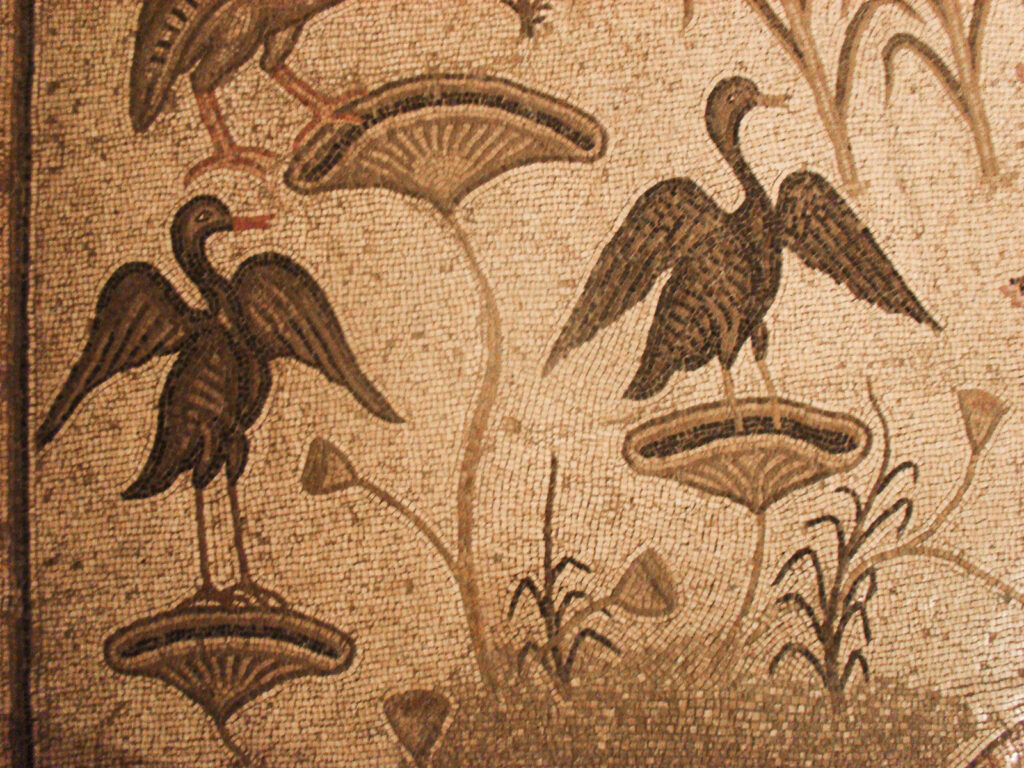
The central plant element in the Nilotic scenes is the sacred lotus (Nelumbo nucifera), which appears in its various stages of development: buds, open flowers and a thickened, cup-like receptacle bearing nutlets. Around it are set the birds, the fish, the animals and the other water plants. Its recurring appearance defines the scene as Nilotic and distinguishes it from depictions of the local landscape.
Inscriptions such as “Egypt” and “Alexandria” signal to the viewer that the particular panel depicts the landscapes of the Nile and Egypt, in contrast to the other panels in the mosaic, which depict local reality. Mosaics in which an entire room is devoted to a Nilotic landscape are few, and in the Land of Israel they are found only at Tabgha and at Sepphoris. In the great Nile mosaic from Palestrina in Italy, identifying inscriptions accompany the animals and the places, and the whole mosaic is a visual encyclopaedia of species for the benefit of the viewers: enrichment, learning and pride in the return from a journey. It seems that the journey lasted several years, and that the artisans who made the drawings took part in it. Thus one of the finest mosaics in existence was created, alongside the Alexander mosaic from Pompeii. Both mosaics depict reality, and their role is documentation.
The Nilotic scenes document a landscape that was not part of the viewers’ everyday surroundings. They reflect journeys to the land of the Nile for trade, social and political ties, religious needs and hunting, which characterized the elites of the Late Roman and Byzantine periods.
Roman sources describe journeys up the Nile. Pliny the Elder, who relays the reports of the expedition sent in the days of Nero, writes that around Meroë greener grass and woodland begin, and that tracks of rhinoceroses and elephants were seen there (Natural History 6.184–185). Meroë lay some 200 km north of the area where the White Nile and the Blue Nile meet, where Khartoum stands today and where the savannas begin. A record of the savanna landscapes themselves is found in the Lod mosaic.
The Nilometer, the installation for measuring the height of the Nile, appears in several of the Nilotic mosaics. The Nilometer of Alexandria stood east of the Roman compound of the Serapeum. The measuring of the Nile was linked to the cult of Serapis: the measuring cubit was kept in the temple, and Constantine ordered it transferred to the church (Socrates Scholasticus, Ecclesiastical History 1.18). The Serapeum was destroyed in 391–392. The mosaic of the Nile Festival Building at Sepphoris depicts the Nilometer of Alexandria, on the hill of the Serapeum.
In the mosaic of the Nile Festival Building at Sepphoris, in the band of birds in its upper part, two male pheasants hold in their bills the wreath of roses around the inscription. On either side of them stands a heraldic pair of partridges, the right one a male with a spur and the left one a female, and further partridges peck at the ground and at the rose flowers. Beside them are two doves, and between them the tail of another pheasant can be seen. The pheasants, the partridges and the doves are a group of birds that were kept in captivity, and they are discussed in the chapters of their distribution.
In the mosaic of the Church of the Multiplication of the Loaves and Fishes at Ein Sheva–Tabgha an especially large concentration of birds is depicted, in an extensive Nilotic carpet that also includes a Nilometer.
The northern Sea of Galilee lies in the Rift depression, some 200 metres below sea level. The warm climate, the springs, the delta of the upper Jordan in the Bethsaida Valley (the Batiha) and the Ginosar Valley together create an expanse of marshes, water plants and abundant fish. In this expanse live heat-loving species and species of African origin. Prominent among the plants are the Christ’s thorn jujube, of Sudanian origin, and the papyrus sedge, and among the fish the Galilee tilapia (St Peter’s fish) and the African sharptooth catfish. The character of these landscapes is close to that of the Nile landscapes, and people of the period noted the resemblance. Josephus reports that some thought the spring of Capernaum to be a branch of the Nile, because the coracinus grows in it, the fish that also grows in the lake near Alexandria (The Jewish War 3.10.8).
The springs of Tabgha (Ein Sheva) were used for irrigation in antiquity. East of the church a hollow basalt water tower was built in the Roman period over the Job Spring. The tower raised the level of the spring water to the height of an irrigation channel that led westwards to the Ginosar Valley, and inside it a system of gradations was installed for measuring the height of the water. It is possible that the water-raising installation was built under the inspiration of the waterworks and Nilometers of Egypt, which the builders of the place knew at first hand.
The church mosaic depicts a Nilometer incised with gradations and Greek letters, similar to the Nilometer in the Nile Festival Building at Sepphoris. It seems that the artisans combined two insights here: their direct familiarity with the Nilometers of Egypt, and the local water system. The idea current in the period, that the Sea of Galilee is connected to the Nile, allowed them to compare the northern Sea of Galilee to the mighty system of the Nile. For this reason they did not trouble to write “Alexandria” or “Egypt”, as was done at Sepphoris, in the House of Leontis and at Hadid (Haditha), and for this reason the mosaic is large and entirely Nilotic.
The artisans went down to Egypt, to the Nile Delta and to Alexandria, observed the birds there, and rendered them in the mosaics in an original design. The Crowned Crane raises two possibilities: the artisans travelled up the Nile and observed the cranes in the wild, or they saw them in captivity in Lower Egypt.
The Nilotic mosaics are a visual expression of the memory of a journey. The artisans conveyed to the local community impressions, knowledge and experience from a distant world, and presented to it the achievements of the patrons of the buildings.
Sandpiper
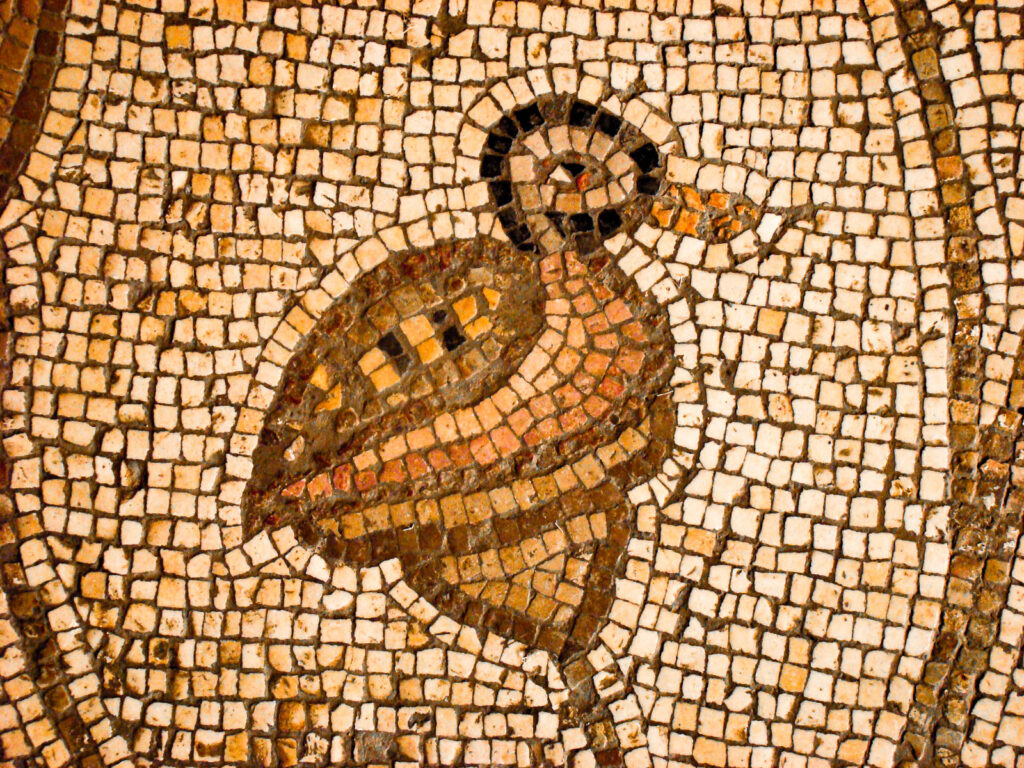
The sandpiper is depicted in a single mosaic, in the Nilotic carpet of the Church of the Multiplication of the Loaves and Fishes at Ein Sheva–Tabgha in Lower Galilee, identified to genus level. The sandpiper is a small and delicate waterbird of the waders, with slender legs, a narrow, elongated bill and a small body in a characteristic standing posture. Sandpipers are active at the edges of bodies of water, in marshes and on shallow banks. They walk among the vegetation and pick insects, invertebrates and tiny animals from the mud and the shallow water.
At Tabgha sandpipers are depicted sitting in a slightly hunched posture, characteristic of the genus, and another sandpiper stands on the thickened, cup-like receptacle of a sacred lotus. The birds are set among the lotus stems, the buds and the receptacles bearing nutlets, within dense water vegetation.
The sandpipers are part of a wide array of further Nilotic birds, water plants and a rich marsh world along the carpet. The artisans took care over the details characteristic of small waterbirds and their habitats.
Red-breasted Goose
Barbary Partridge
Stint
Black Crowned Crane
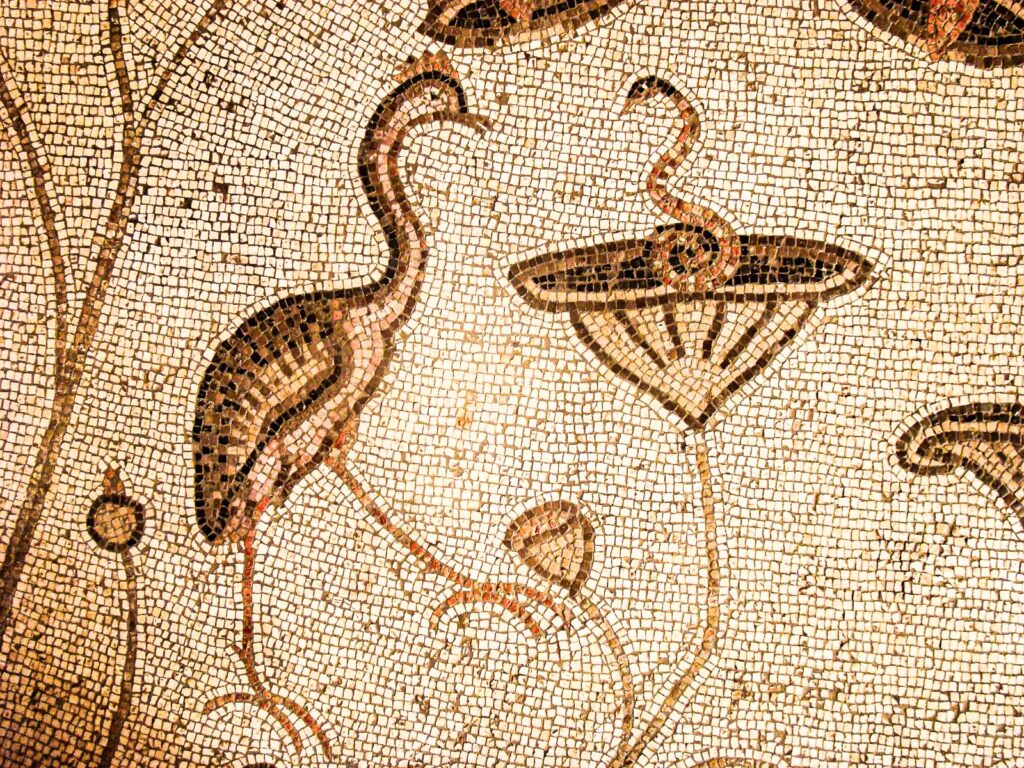
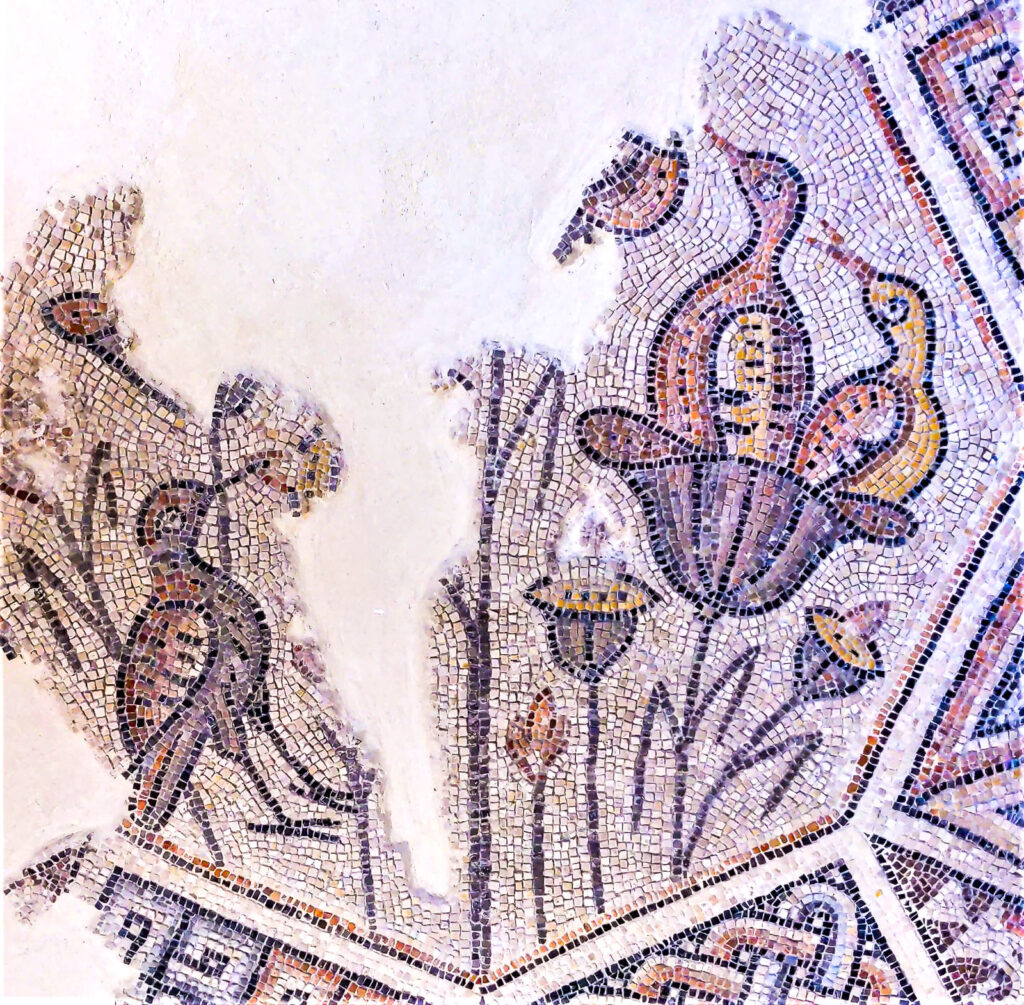
The Black Crowned Crane (Balearica pavonina) is depicted in a single mosaic, in the Nilotic carpet of the Church of the Multiplication of the Loaves and Fishes at Ein Sheva–Tabgha in Lower Galilee. It is one of the most impressive African birds in the mosaics of the Land of Israel, and it is not part of the country’s fauna.
The identification rests on the large body build characteristic of cranes, the long legs, the elongated neck and the golden crest spread like a crown on the head. The artisans rendered the identifying features in detail: a well-developed golden crest, a large white patch on the side of the head, a reddish tone on the forehead and along the neck, a long neck in an S-shaped curve, and a pale tone along the neck and the breast. The wings are rendered with a dark upper part in grey-black tones and a paler lower part, and the tip of the tail is thickened in black-reddish tones. The proportions, the length of the legs and the upright standing posture also match the crowned crane.
The crane stands facing an Egyptian cobra, whose body is coiled inside the cup of a sacred lotus and whose head rears up towards it. The crane’s posture, the direction of its body and its closeness to the snake depict a moment of confrontation before predation. Crowned cranes feed on arthropods, molluscs, amphibians and small and medium-sized reptiles, as well as on seeds and plant matter. Like other large marsh birds they also contend with snakes, among them small and medium-sized venomous snakes: they strike swiftly with the bill, leap back, tread on the prey and swallow it whole or in pieces. The size of the snake in the mosaic is consistent with such a confrontation.
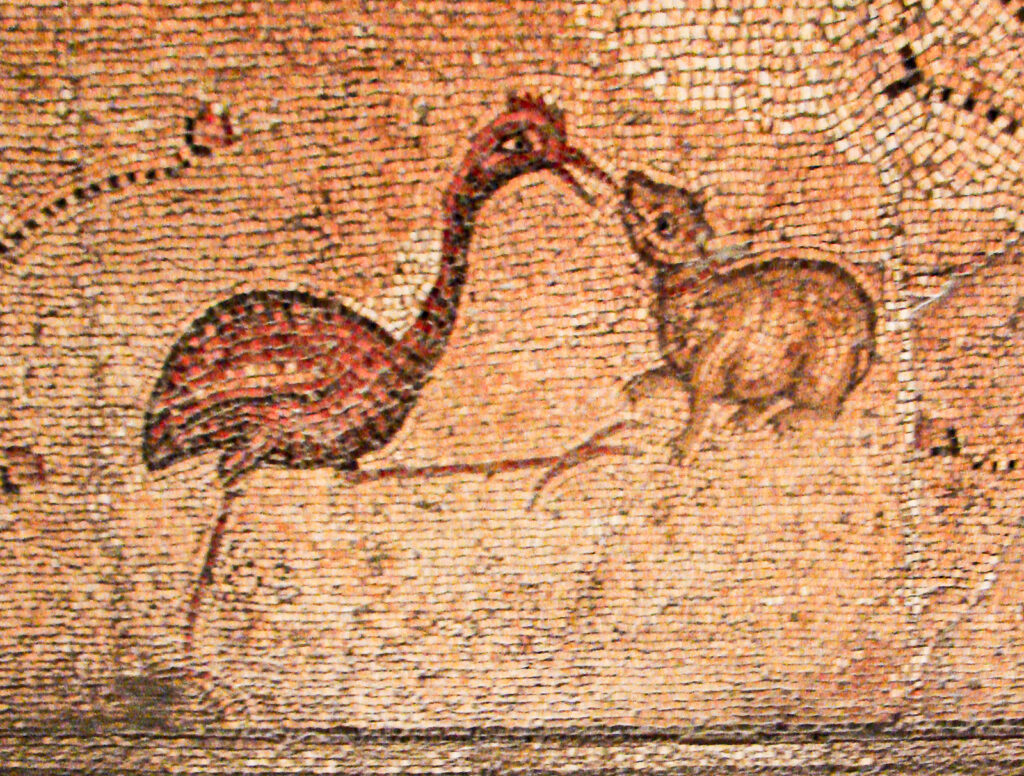
In another scene at Tabgha a crowned crane stands facing a tame mongoose wearing a red collar around its neck. This is an original and unique depiction, highly realistic. Tame mongooses are depicted in four mosaics from the Land of Israel: in Jerusalem, at Be’er Shema, at Sde Nahum and at Tabgha (Gorzalczany and Rosen 2020). A mongoose raised from a young age becomes accustomed to humans, and from antiquity mongooses were kept for hunting snakes. In Egypt the mongoose was valued as a predator of snakes and an eater of crocodile eggs. At Be’er Shema and at Sde Nahum the mongoose wears a collar and stands in a fighting stance, apparently facing a snake, and in Jerusalem it is harnessed.
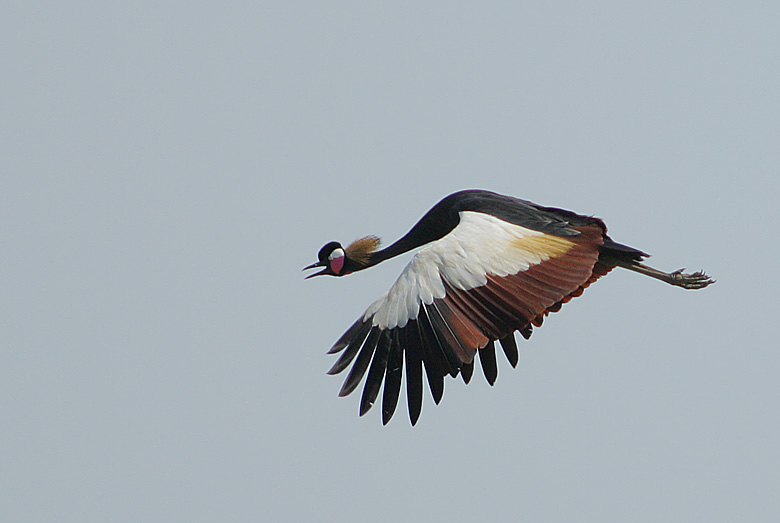
The crowned crane is tied to wet habitats: marshes, lake margins, floodplains and wet grasslands. The Black Crowned Crane lives in the Sahel belt, from Senegal to Ethiopia, and its largest population is in the Sudd swamps of the upper Nile in South Sudan, and in western Ethiopia.
The appearance of the crowned crane at Tabgha raises two possibilities: the artisans travelled up the Nile and observed the cranes in their habitats, or they saw them in captivity in Lower Egypt. The crane, the cobra and the lotus are depicted together as part of a single fabric of the water landscapes of the Nile, and the precision of the depiction attests to direct observation of living birds.
Common Pochard
Great Cormorant
Eurasian Teal
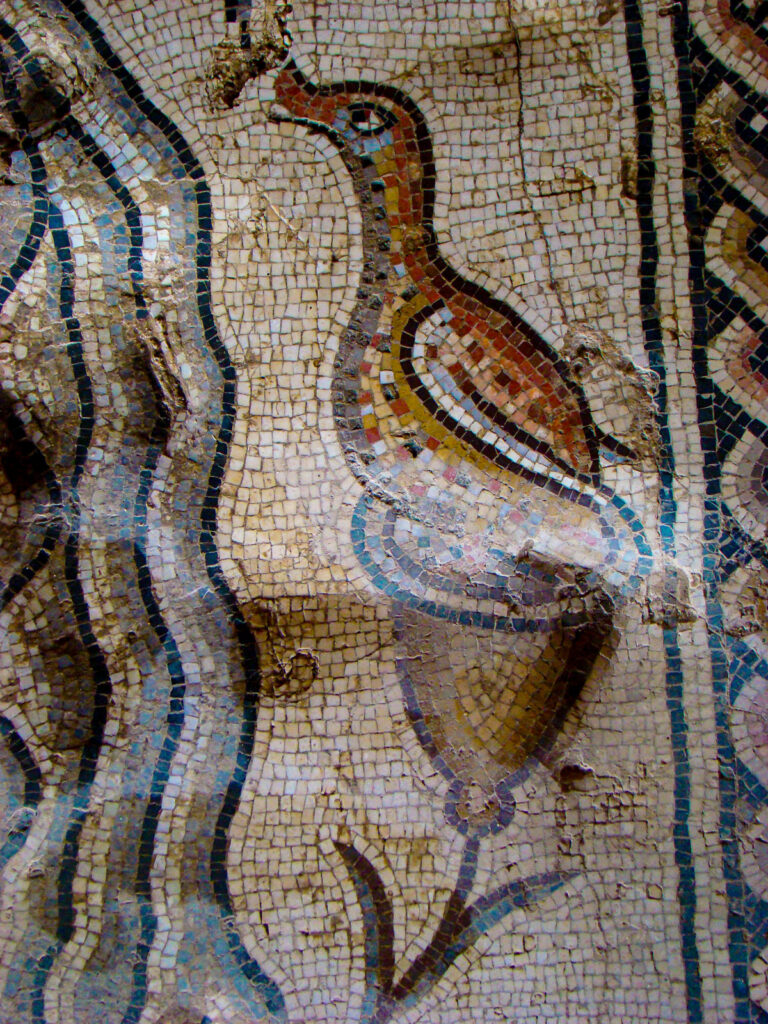
The Eurasian Teal is depicted in a single mosaic, in the Nile Festival Building at Sepphoris in Lower Galilee, where all the ducks are teals. Three teals are depicted in it: one in the hands of a boy personifying a cubit, offered to the Nile god; one sitting on a lotus in the Pelusiac branch; and one on a lotus in the main stream of the Nile.